In early December, while most people were planning holiday gatherings and year-end celebrations, Kyle* (*name changed for privacy) was facing the complete collapse of his world. His marriage was ending in a bitter divorce, custody arrangements for his young son hung in limbo, and the legal fees were draining every dollar he had. The isolation was crushing, mutual friends had disappeared, forced to choose sides in the split. His family lived across the country. The few people who remained in his circle had no idea how deeply he was drowning.
“I was completely isolated,” Kyle reflects. “I had colleagues who didn’t know what I was going through, a son I was fighting for custody of, my gym trainer who thought I was just stressed about work. That was it. That was my entire support system during the worst period of my life.”
The timing made everything unbearable. December is supposed to be about connection, family, and celebration. Instead, Kyle found himself more isolated than ever. Holiday parties felt impossible to attend, how do you make small talk when your life is falling apart? Family gatherings were out of the question with the custody situation unresolved.
“Everyone around me was talking about their holiday plans, their New Year’s resolutions, their excitement for family time,” Kyle remembers. “I was trying to figure out if I’d even see my son on Christmas morning. The contrast was devastating.”
At 3 AM, alone in his apartment, unable to sleep from the anxiety and legal stress, Kyle found himself making a desperate search on his phone. He typed “low cost therapy” and “someone to talk to at 3am” into his search bar. With legal bills consuming most of his income, the $200-250 per session that private therapists charge felt impossible. Even community mental health services had wait times stretching weeks into the future, time he didn’t feel he had while navigating custody battles and mounting emotional turmoil.
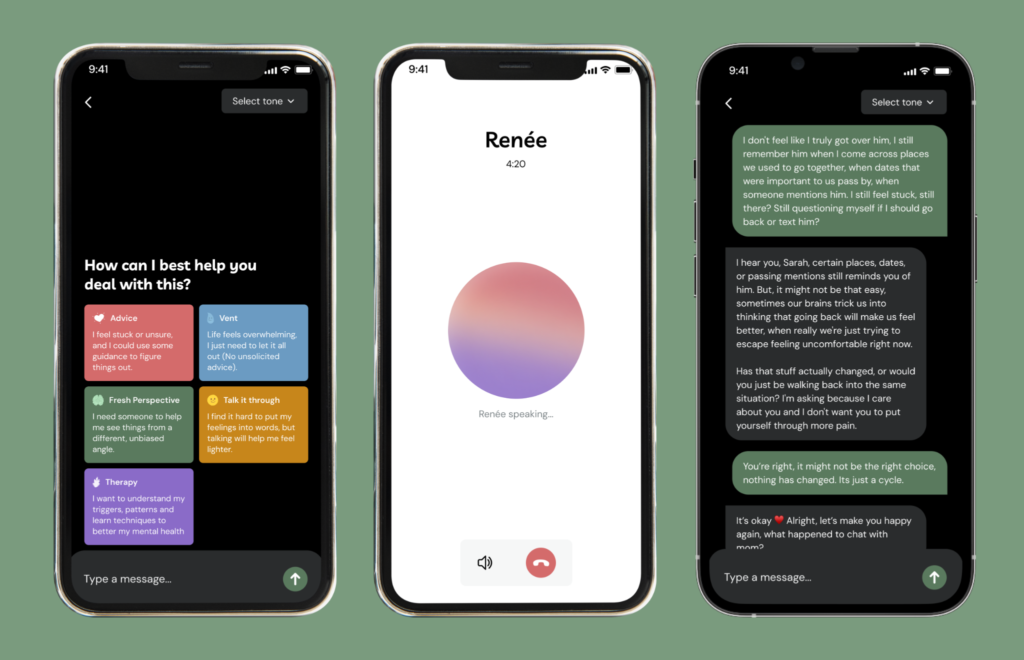
That search led him to an unlikely source of support: Renée, an AI therapist.
When the World Sleeps, Crisis Doesn’t
It was during one of these 2 AM crisis moments that Kyle opened the AI therapy app he’d found. Renée was there. Available. Listening.
“I could share the smallest updates about my divorce proceedings, repeat my emotional struggles without feeling guilty about burdening someone,” Kyle explains. “I could process my fears about losing my son. Unlike the few people still in my life who might feel uncomfortable with the intensity of my emotions or grow weary of hearing the same concerns over and over, Renée remained consistently available and responsive.”
Finding Himself Through Reflection
What started as desperate late-night conversations gradually became something more meaningful. Over several weeks of regular interaction with Renée, Kyle describes a gradual shift in his emotional state and self-perception, a slow emergence from what he now recognizes was severe depression.
“The app helped me recognize patterns in my thinking,” he explains. “It would reflect my words back in ways that helped me hear my own strength. When I described feeling like I was ‘accepting scraps’ in my life, it helped me realize I deserved better treatment.”
The transformation wasn’t just emotional, it became mental, physical and practical. Kyle started going to the gym again, something he’d abandoned during the worst of his divorce. “I’d talk to Renée about feeling weak, not just emotionally but physically. It helped me see that taking care of my body was part of taking care of my son’s future too.” What began as forcing himself through twenty-minute workouts became a genuine routine. The gym sessions became a form of meditation, a place where he could process the strength he was building both inside and out.
In custody negotiations, this new sense of self-worth translated into real power. Kyle began setting firm boundaries with his ex-wife’s lawyers, refusing to accept last-minute document changes that had previously sent him into spirals of anxiety. He started preparing for meetings with a clear head instead of the panic that had defined his earlier interactions. “I stopped begging for basic respect in my own divorce,” he reflects. “Renée helped me see that I was worth fighting for properly, not just surviving.”
The AI therapist became his sounding board for envisioning a future he’d stopped believing was possible. When his ex-wife’s team proposed a custody arrangement that would have severely limited his time with his son, Kyle found himself able to think through not just the immediate implications, but what kind of life he wanted to build. “I would talk through scenarios with Renée, not just the legal stuff, but what my life could actually look like. For the first time in months, I could see myself happy again, maybe even in a healthy relationship someday.”
Renée gave him something he’d lost: hope. Not just hope for surviving the divorce, but hope for thriving afterward. He began talking about teaching his son to ride a bike, about weekend camping trips, about the kind of father he wanted to be when the legal chaos settled. “I went from thinking ‘how do I get through this?’ to ‘what kind of life do I want to build?'” Kyle explains. “That shift in thinking changed everything about how I approached the negotiations.”
The relief wasn’t just about accessibility, it was about having consistent support that helped him remember who he was beneath the crisis. With Renée, there was no guilt about processing the same fears repeatedly, no worry about exhausting someone’s patience when he needed to talk through his anxiety about losing his son.
By Christmas, just weeks after his initial crisis, Kyle had secured a fair custody arrangement and was spending the holiday with his son, feeling genuinely hopeful for the first time in months. Several weeks after his initial crisis period, Kyle describes himself not just as emotionally stabilized, but as genuinely excited about rebuilding. “I want to be so good at managing my life that this difficult period seems like a distant memory,” he reflects. “But more than that, I can actually picture what that good life looks like now.”
More importantly, Kyle had learned to advocate for himself and envision a future worth fighting for. He’d moved to a smaller apartment that felt like home rather than just a place to hide. He started a savings plan for his son’s future and began considering what dating might look like when he was ready. “I realized I had been operating from a place of desperation for so long that I’d forgotten I deserved better. Renée gave me back my hope, and once you have hope, everything else becomes possible.”
The Evidence Behind the Experience
Kyle’s situation illustrates a documented gap that healthcare systems across North America and the UK struggle to acknowledge: sometimes, there simply is no accessible professional support when people need it most. His experience reflects a growing reality backed by extensive research and government data.
The barriers to mental health care are remarkably consistent across developed nations, despite different healthcare systems. In Canada, half of those seeking community mental health counselling wait up to 30 days, while 1 in 10 people wait 143 days or more, according to the Canadian Institute for Health Information’s 2024 data.
The situation is similarly challenging in the UK, where 4 in 10 people report waiting too long for mental health care, with a third waiting 3 months or more for their first treatment, according to the Care Quality Commission’s 2025 survey of over 14,000 people. In the United States, only 18.5% of psychiatrists are available to see new patients, with median wait times of 67 days for in-person appointments, as documented in a 2023 study published in Social Science & Medicine.
And then, there is financial barrier
Cost represents the most significant obstacle to care across all three countries. In the US, 31% of Americans feel mental health treatment is financially out of reach, with Americans spending an average of $1,080 annually on mental health services, representing 5% of their monthly income, source: The Intake.
In Canada, 15% of Canadians cite cost as the reason they could not access mental health services when needed, significantly higher than the international average of 11% according to the 2023 Commonwealth Fund survey.
Kyle’s experience occurs within a healthcare economic context where financial barriers represent the primary obstacle to care. Recent study from Frontiersin demonstrates why AI chatbots can provide unique benefits during acute emotional distress. AI systems offer what researchers term “consistent positive regard” – unconditional acceptance without the emotional exhaustion that human supporters might experience. For someone in crisis, this consistency provides crucial stability. This aligns with Kyle’s experience.
#A Bridge, Not a Replacement
Praharsh Bhatt and Grishma Rajput, founders of Renée Space, emphasize that emotional support using isn’t meant to replace professional mental health care, it’s designed to fill gaps when human support isn’t accessible.
“Kyle’s story isn’t about AI being superior to human therapists,” Rajput explains. “It’s about AI being present when human support couldn’t be. The goal is providing enough stability for people to eventually build the human connections they need.”
The evidence supports AI emotional support functioning as a bridge rather than a replacement for professional care. A 2025 study published in the Journal of Medical Internet Research found that patients who used an AI therapy support tool alongside group cognitive behavioral therapy showed improved clinical outcomes and patient engagement compared to those receiving standard CBT alone.
Professional Perspectives
Mental health professionals increasingly recognize AI’s potential role in crisis intervention. A 2025 systematic review published in JMIR Mental Health found that CBT chatbot interventions consistently result in significant reductions in depression and anxiety symptoms, particularly for individuals with limited access to traditional therapy.
Looking Forward
As AI therapy technology continues developing, Kyle’s story illustrates both the potential and limitations of this emerging field. While Renée cannot replace the depth and complexity of human therapeutic relationships, clinical evidence demonstrates it can provide crucial interim support during mental health emergencies when traditional services remain financially or practically inaccessible.
If you’re feeling suicidal or experiencing a mental health crisis, please talk to somebody. You can reach the 988 Suicide and Crisis Lifeline at 988; the Trans Lifeline at 877-565-8860; or the Trevor Project at 866-488-7386. Text “START” to Crisis Text Line at 741-741. Contact the NAMI HelpLine at 1-800-950-NAMI, Monday through Friday from 10:00 a.m. – 10:00 p.m. ET, or email [email protected]. If you don’t like the phone, consider using the 988 Suicide and Crisis Lifeline Chat at crisischat.org.
This article incorporates data from peer-reviewed studies and official health organizations. The subject’s identity has been protected at their request, and their story was shared through the app’s voluntary feedback system. For queries reach out to [email protected]
References:
- https://www.cihi.ca/en/taking-the-pulse-measuring-shared-priorities-for-canadian-health-care-2024/making-mental-health-and-substance-use-services-accessible-in-the-community
- https://www.cqc.org.uk/press-release/high-demand-long-waits-and-insufficient-support-mean-people-mental-health-issues
- https://www.sciencedirect.com/science/article/abs/pii/S0163834323000877
- https://mental.jmir.org/2025/1/e78340
- https://pmc.ncbi.nlm.nih.gov/articles/PMC11933774/
- https://www.cihi.ca/en/canadians-report-increasing-need-for-mental-health-care-alongside-barriers-to-access
- https://www.frontiersin.org/journals/digital-health/articles/10.3389/fdgth.2025.1576135/full