
The first few minutes after a fall are a blur. Pain and embarrassment create the same urge: get up off the floor and out the door before anyone makes a fuss.
That instinct is expensive. The spill gets mopped within the hour, and the video gets overwritten by the weekend, usually before anyone asks what the floor looked like when you stepped on it. Louisiana recorded 11,031 hospitalizations caused by unintentional falls in 2023, according to the state Department of Health’s 2024 Health Report Card.
Your health comes first. After that, the job is narrow: keep an accurate record of the condition you encountered and the symptoms you felt, while both are still fresh and still verifiable.
What to Do First After an Injury on Someone Else’s Property
Move out of danger, then decide whether you need an ambulance
Get away from the hazard if you can do it safely. Call 911 for anything serious or potentially serious, and ask someone nearby to find the property owner or a manager. Severe bleeding ends the debate, and so does a loss of consciousness. Trouble breathing or chest pain, the same. A suspected head or spinal injury means you wait for paramedics, and if your legs won’t hold you, that counts too. None of it should be traded for a conversation about paperwork.
Nothing in this article is worth a second injury. Skip any step that keeps you standing in a dangerous spot or delays care, and come back to it later if you can.
If a head, neck, or back injury is possible, the injured person generally should not be moved unless staying put is more dangerous than moving. Detailed first aid comes from responders or another qualified clinician, not from a bystander working off memory.
Report the injury without guessing about fault
Tell the owner or manager as soon as you safely can. Give the date and time, as close to the minute as you can, plus the exact spot. Describe the condition you encountered and the symptoms you already feel. Don’t guess about fault, and don’t sign anything you haven’t read.
Ask the owner, or whoever is managing the property that day, to create an incident report, then get a copy or photograph the finished page before you leave. If nobody will produce one, send a short written account by email or another traceable method once you’ve been treated. An undocumented exit invites an argument later about where and when this happened, about which employees were on the clock, and about who cleaned the area afterward.
Describe only what you observed. Don’t speculate about how long a puddle sat there or which employee walked past it. Those details matter when seeking New Orleans Premises Liability Cases support, and a guess you offered while dazed can undercut the accurate account you give a week from now.
Not every private-property incident calls for police. Officers and paramedics step in when there’s an emergency or a possible crime. A traffic-related event or another matter within their authority brings them out too.
Seven Slip and Fall Mistakes That Can Weaken the Record
Here’s the short version of what tends to go wrong and what to do instead. The first row is covered above; the remaining rows are explained below.
| Mistake | Practical alternative |
| Leaving without reporting the incident | Notify the owner or manager and request an incident report. |
| Taking no photographs or video | Document the condition and surrounding area without changing the scene. |
| Discarding shoes or damaged belongings | Photograph and store relevant items without cleaning or repairing them. |
| Losing track of witnesses | Request names and contact information when it is safe to do so. |
| Delaying appropriate medical attention | Seek care based on the seriousness of your symptoms. |
| Posting detailed updates online | Preserve existing content and avoid new accident-related posts. |
| Assuming documentation proves liability | Recognize that evidence preserves facts but does not decide legal responsibility. |
Photograph more than the puddle
Most people take one close-up of the wet spot and stop. That photo does less work than you’d think, because it shows a slick floor without showing which floor it is, or where you were standing when it took your feet out from under you.
Shoot the hazard where it sits, then back up. Frame the walkway or stair run, the overhead light, and any handrail within reach. Take one wide shot that makes the location unmistakable. Add images of visible injuries and anything of yours that broke, like a cracked phone screen or a torn bag.

Capture the condition and the surrounding location without rearranging the scene.
Don’t rearrange anything. If it’s safe, shoot the same condition from a few distances and keep the original files. A screenshot or a social upload is a compressed copy, not the thing itself.
Photographs have a built-in ceiling, though. Yours can establish that a condition existed at 4:52 on a Tuesday. Whether it had been there four minutes or four hours is a separate question, and it comes up again below.
Don’t clean, repair, or throw out what you were wearing
Footwear tells part of the story, and so does torn clothing. A broken bag or a damaged mobility aid can add to it.
Cleaning or repairing an item strips out information nobody can put back. Testing it does the same. So does wearing it for another six months.
Set it aside, let it air-dry if it’s wet, then photograph its condition and put it in a labeled box. Then leave it alone. Shoes rarely prove or disprove anything by themselves, and what they’re worth depends on the facts around them.
Get witness names before people walk off
Witnesses leave. The shopper who noticed the spill twenty minutes before you did, or who watched how staff responded afterward, is gone the moment they finish checking out, and there is usually no practical way to find that person again.
Ask for a name and the best way to reach them, whenever it’s safe to do so. Write down what they told you in your own notes, without steering anyone toward particular wording. If you want a photo of an employee’s badge, ask permission first and follow the property’s rules. Otherwise, a written name or job title will do.
Match the care to the symptom, and don’t wait
Emergency treatment and a same-week appointment are two different decisions. A serious injury goes to the emergency room. Milder symptoms usually mean urgent care or your own physician, promptly rather than eventually. Early treatment identifies what’s wrong and creates a dated medical record as a byproduct, which matters for your health first and your paperwork second.
According to Louisiana public health data, accidental falls represent the single largest driver of nonfatal injury visits statewide. While specific demographics experience higher rates of severe harm from motor vehicle collisions or drug toxicity, fall-induced trauma remains the most widespread cause of non-fatal harm. Because physical symptoms often take 48 to 72 hours to fully manifest, delayed soreness or stiffness is a reason to see a professional for evaluation.
Describe your symptoms accurately and follow the instructions you’re given. Keep the discharge papers and the bills. Put test results in the same folder, along with any referral or written work restriction.
Post nothing about the fall
That covers your theory about whose fault it was and the photo of the scene you already took. It also covers medical updates and jokes about what your knee can’t do anymore.
Preserve what’s already up. Check your privacy settings, and get case-specific legal advice before deleting relevant posts, because deleting can take useful information with it.
Public posts travel without the context you intended, and so do location data and the replies underneath. A quick “I’m fine” typed from a store parking lot says nothing about the stiffness and headaches that arrive on Thursday. Privacy settings help; they don’t make anything confidential.
Documentation is not the same thing as liability
A complete file documents what happened to you. It doesn’t establish who is legally responsible, and in Louisiana those are two different projects with two different requirements.
The governing law sits in two places. Louisiana Civil Code article 2317.1 addresses an owner’s or custodian’s liability for damage caused by a defect, where that person knew or should have known of it and could have prevented the harm through reasonable care. Claims against merchants, a category that covers grocery stores and restaurants, run through Louisiana Revised Statutes section 9:2800.6 instead.
Statutory premises liability hinges on four distinct elements. First, the plaintiff must establish that the condition posed an unreasonable, foreseeable hazard. Second, the evidentiary burden requires proving notice—demonstrating that the business either created the hazard or had actual or constructive knowledge of its existence. Constructive knowledge is primarily a function of time: the peril must have persisted long enough that a prudent operator conducting routine inspections would have identified it. Third, the claimant must show a breach of the standard of care, and finally, present clear proof that this breach directly caused the quantified injuries and financial losses.
When the Injury Is an Emergency or Symptoms Appear Later
Emergencies change the order of priorities
Never delay an ambulance to finish documenting anything. If someone is with you, hand off the work. That person can report the incident and get the location on camera while you’re being treated, and can collect witness details if anyone is still standing around. Ask them to hold onto your belongings too.
If you were alone, missing the photographs isn’t a mistake and isn’t something to apologize for. Write down what you remember once you’re medically stable.
The emergency generates its own paper trail. Ambulance and emergency response records carry useful information, hospital discharge documents do the same, and so does the bag of clothing and personal items medical staff hand back to you. Note the name and street address of the property while it’s fresh.
Delayed symptoms still require a dated record
Pain that surfaces three days later still counts, and so does dizziness. Swelling and numbness count. So does a range of motion you’ve quietly lost.
Seek medical guidance based on how severe the symptom is, and tell the clinician when the fall happened. Note when it began and how it changed. Add what it stopped you from doing, then preserve whatever records come out of the visit.
Don’t diagnose yourself, and don’t rewrite an earlier account to make late symptoms look immediate. A clinician can document a delayed symptom as exactly that.
Keep a factual symptom and treatment timeline
A dated log takes a few minutes a week. Note symptoms as they appear or change, and add every medical visit and referral. Include missed shifts and work restrictions. Do the same for receipts and travel tied to your care.
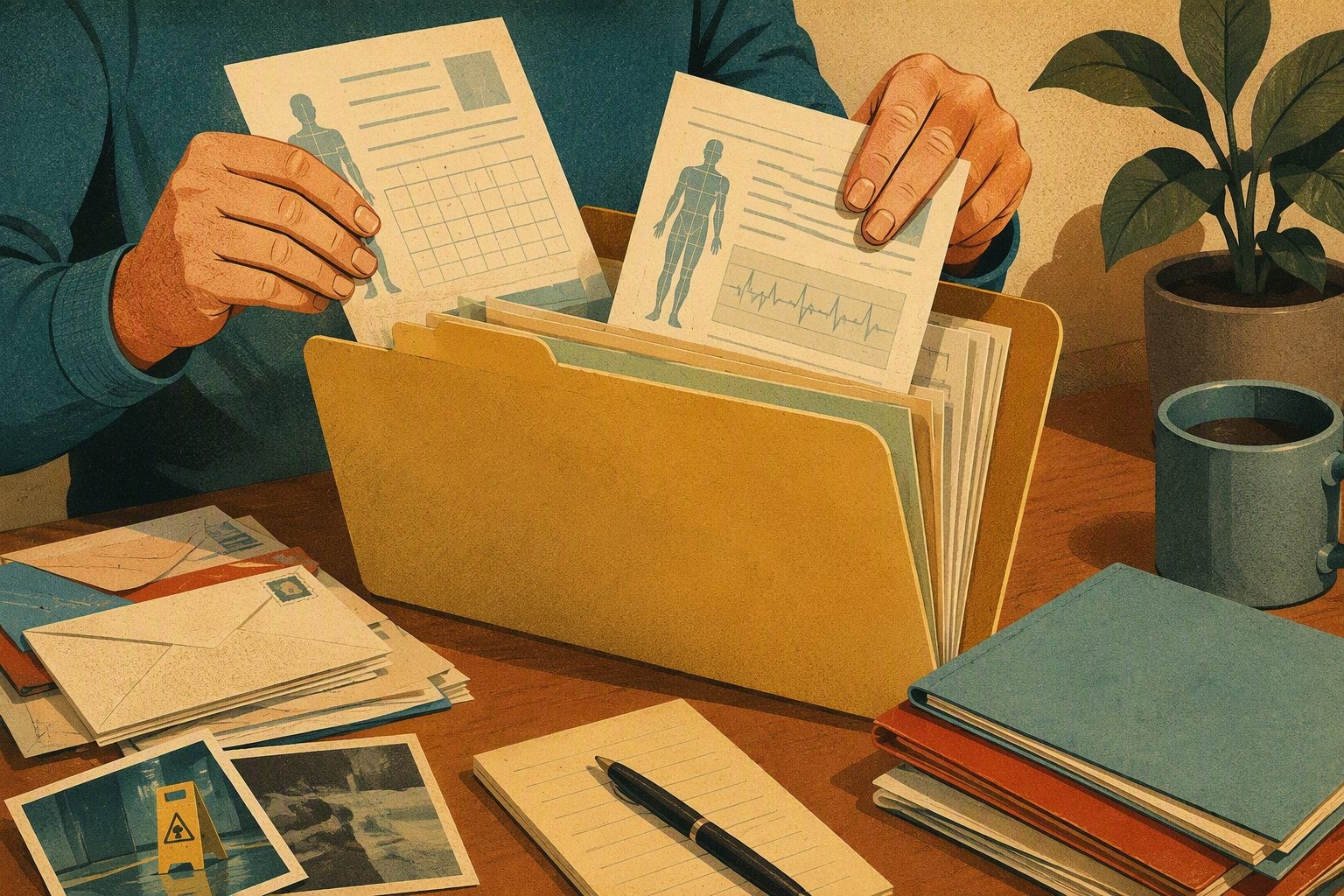
Keep the original reports and treatment records in one place, along with any correspondence.
Put calls and letters from the property owner or an insurer in the same file. Keep the entries concrete. Skip the dramatic adjectives and any diagnosis you haven’t actually received.
How to Preserve Slip and Fall Evidence Without Altering It
Keep the originals
Preserving evidence mostly means leaving it alone. Back up the original photographs and video in a way that keeps the filenames and dates intact, along with the embedded file information. Hold onto emails and text messages in whatever form they arrived, and treat receipts and other documents the same way.
Don’t edit the embedded information, and don’t annotate the originals. When an insurer or property representative calls, write down the date, the caller’s name, the organization, and what was discussed. Written notes are safer than recording the call, at least until you have guidance about which laws apply.
Ask for preservation early, without overstating what must be produced
Surveillance footage is often overwritten on a rolling schedule, sometimes within days. Maintenance logs and inspection sheets can matter as much as the video does.
A prompt written request identifies the material you’re asking the recipient to retain, and it’s worth naming the cameras you noticed near the spot while you can still picture them. Keep a copy of anything you send, with proof of delivery.
Track dates, but don’t do the deadline math casually
Put the incident date in one place and keep your treatment and correspondence dates with it. Include the date you reported the injury, too.
Which filing deadline applies can depend on when the injury occurred and on the nature of the claim, along with other facts specific to your situation. Record the incident date immediately and get current, case-specific guidance rather than assuming a general online deadline covers every Louisiana property claim. Confirm any date against the current Louisiana Civil Code and applicable legislation, not a blog post, and set a private calendar reminder once you have that guidance.
A Clear Record Is More Useful Than a Perfect Story
Your safety outranks every step described here.
An accurate account of what you actually saw and felt is worth more than a confident reconstruction, because guesses come apart under questioning and plain observations hold up. Preserved evidence, however careful you were with it, still won’t establish the legal elements Louisiana requires in a premises case.
You can’t recreate a hazard once it’s been cleaned or repaired. What you can do today, while you still remember which door you came in through, is write down the date and keep the originals in one secure file.