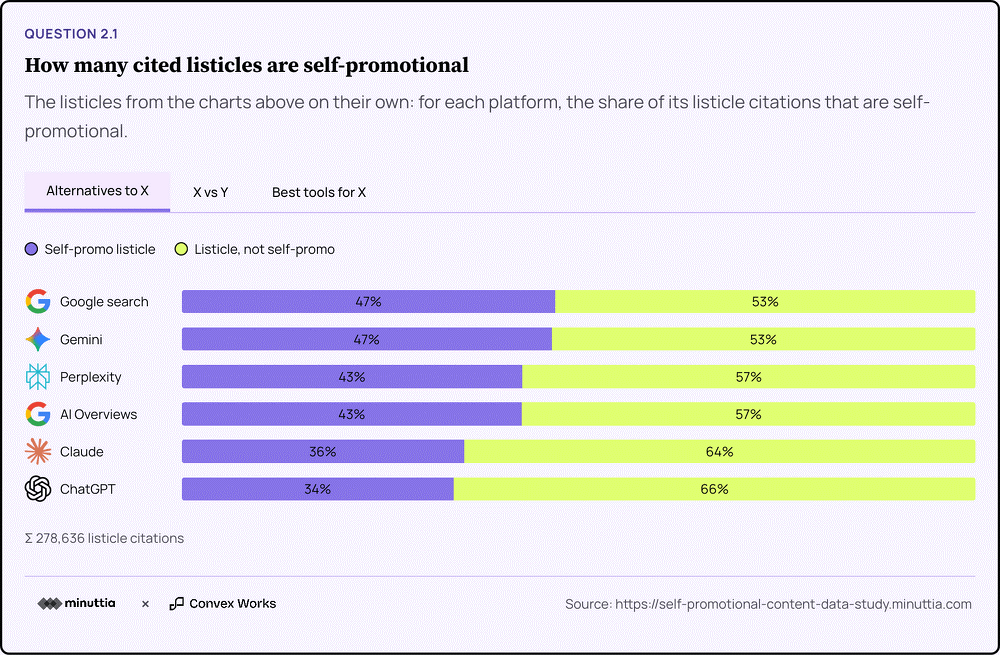
Analysis of 18,084 software questions across Google Search, AI Overviews, ChatGPT, Gemini, Claude and Perplexity finds that 34% to 47% of the listicles cited for “alternatives” questions are a vendor’s own list, rising to 56% to 65% for “X vs Y” comparison questions. 87% of those lists rank the vendor first and only 16% disclose who wrote them.
Minuttia, one of the world’s leading SEO and AEO agencies for SaaS companies, today published the Self-Promotional Content Data Study, its second large-scale study of how AI search answers questions about software. The study looks at self-promotional content: the “best [category] tools” lists and comparisons that software vendors write about their own category, usually with their own product at the top, and measures how often Google and AI assistants cite them when a buyer asks which software to choose.
Minuttia asked 18,084 questions of 3 types on each of the 6 platforms: 11,525 “best alternatives to [product]” questions, 6,363 “how do [product] and [competitor] compare” questions, and 196 “best tools for [category]” questions, covering 5,983 software brands in 196 categories. Every page the platforms cited (311,766 pages, cited 686,749 times in total) was then read and labelled by who published it and what kind of page it is.
The result is the first platform-by-platform account of how often AI search engines and Google rely on vendor-written lists when they recommend software, which categories are the most affected, and what those lists do to earn the citation.
Key findings
1. Between a third and a half of the lists AI search cites are written by a vendor in that category. When asked for alternatives to a product, 34% (ChatGPT) to 47% (Google and Gemini) of the listicles cited are a vendor’s own “best tools” list for a category it sells in. Those lists behave the same way everywhere: 93% highlight the vendor’s product, 87% rank it first, 90% criticise competitors, and only 16% clearly disclose that the vendor wrote the page. Because pages the team could not read were counted as not self-promotional, these shares are a floor.
2. Some software categories are far more self-promotional than others. Across all platforms and question types, a vendor’s own list makes up 43% of cited listicles overall, but the share ranges from 12% to 76% by category. The most self-promotional categories include AI Security Operations Center (76%), Cloud & FinOps (74%), AI Evaluation & Observability (73%), Social Listening (72%) and AI Visibility (65%). The least include Audio Production (12%), Graphic Design (16%) and Healthcare (21%). The market is fragmented: the 20 vendors whose lists are cited most account for only 6% of citations.
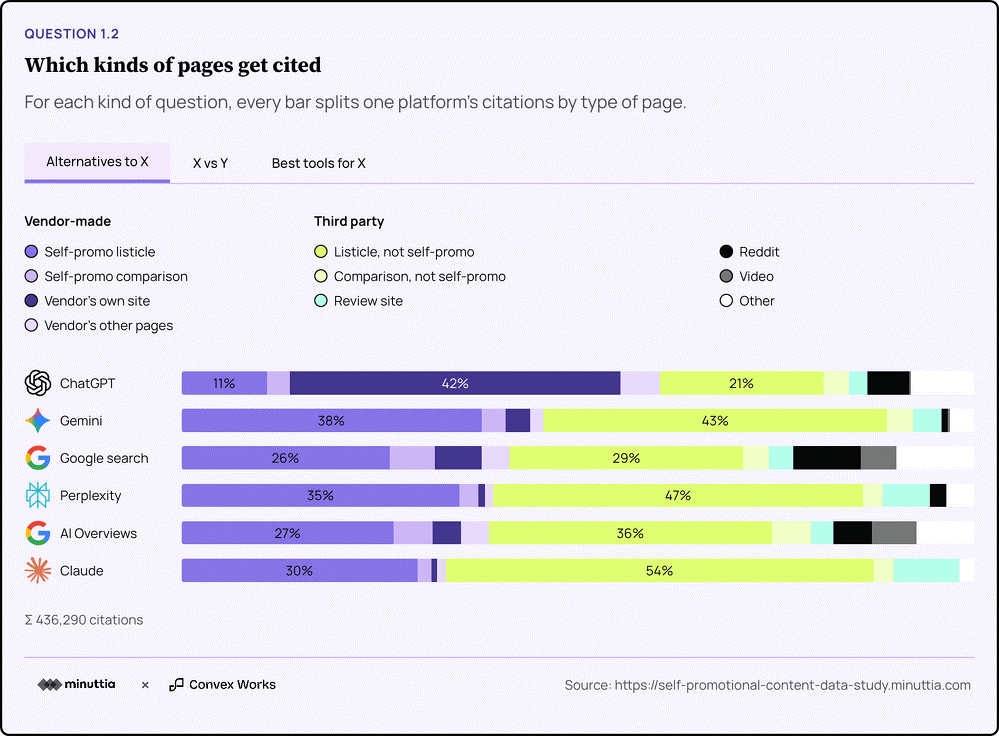
3. ChatGPT searches the vendor’s own website before it answers, and Perplexity cites vendor lists because they rank higher. 71% of ChatGPT’s searches name exactly one product, and 92% of its “site:” searches target the vendor’s own website. On alternatives questions, vendors’ own sites make up 42% of ChatGPT’s citations, against 1% to 6% on the other platforms. Perplexity, by contrast, typically finds about 20 pages and cites 9; whether a page gets cited depends mostly on its position in Perplexity’s search results and on useful editorial features such as a comparison table or a stated selection method, not on promotional language.
“Between a third and a half of the lists AI assistants cite when someone asks for software alternatives were written by a vendor in that category, and only 16% of those pages say so,” said Zacharias Xiroudakis, Managing Director at Minuttia. “Each platform picks its sources differently. ChatGPT goes to the vendor’s own website, Perplexity rewards pages that rank well and are useful to read, and the share of vendor lists ranges from 12% to 76% depending on the category. We published the data behind every chart so that SaaS teams can check our work and see what applies to their own category.”
About the study
The study builds on Minuttia’s first AI visibility study for SaaS companies and uses the same 5,983 brands and 196 categories. Every question was asked on all 6 platforms in August 2026, one answer per question per platform. Every cited page was then read and labelled: who published it, what kind of page it is, and, for lists, where the publisher’s own product sits and which self-promotional patterns the page shows.
Two caveats apply. The self-promotional shares are a floor: pages that could not be read count as not self-promotional. And the results are a snapshot: when Minuttia re-asked Perplexity 2,000 of the questions in September, only 28% of the pages it listed had been in its August answer. The findings hold as shares of kinds of pages and sites, not as a ranking of which page wins.
The full study, the methodology and the data behind every chart are available at self-promotional-content-data-study.minuttia.com. Every chart can be downloaded with its underlying CSV.
About Minuttia
Minuttia is an SEO and AEO (Answer Engine Optimization) agency for SaaS companies. It helps software businesses get found and recommended in Google and in AI assistants such as ChatGPT, Gemini, Claude and Perplexity, and publishes original data studies on how AI search works. More at minuttia.com.
The study was conducted together with Convex Works.
Media contact
Zacharias Xiroudakis,
Managing Director, Minuttia