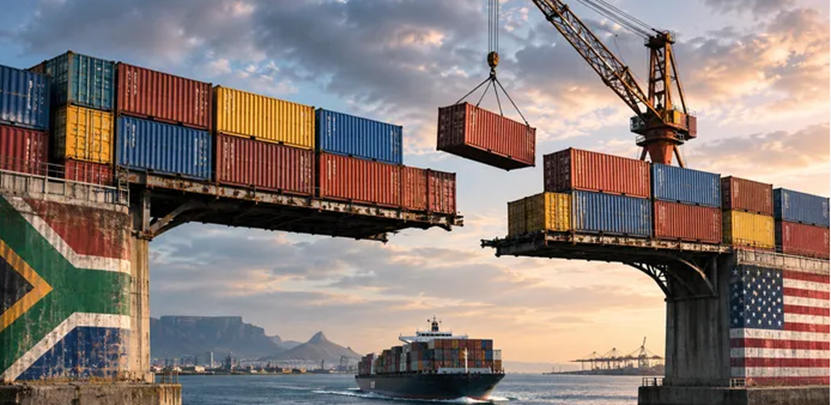
International political decisions can have consequences that extend far beyond diplomatic relations. For South Africa, deteriorating relations with the United States, uncertainty surrounding the African Growth and Opportunity Act (AGOA) and instability in the Middle East are creating an increasingly complicated economic environment.
These developments matter because South Africa depends on international trade for agricultural exports, manufacturing, industrial investment and access to imported goods. When trade preferences are threatened, shipping routes become disrupted or international suppliers face higher costs, the consequences can eventually reach businesses, workers and consumers.
The situation has become particularly significant following the Trump administration’s announcement on 2 November 2026 that it intends to withdraw South Africa’s AGOA benefits from 1 January 2027.
This decision comes despite the United States having extended AGOA through December 2028, illustrating an important distinction: extending the programme does not guarantee that every participating country will retain its eligibility.
At the same time, the conflict involving Iran and wider Middle East instability have increased pressure on international energy markets, shipping routes and agricultural supply chains.
The question is therefore not simply whether South Africa, under President Ramaphosa, will lose preferential access to the American market. It is how the combination of trade restrictions, geopolitical disagreements and supply-chain uncertainty could affect the country’s economic resilience and, ultimately, the cost of living.
What is happening with AGOA and why is South Africa at risk?
The African Growth and Opportunity Act was introduced in 2000 to provide eligible sub-Saharan African countries with preferential access to the American market. Qualifying products can enter the United States without ordinary import duties, giving participating countries a competitive advantage.
South Africa has used AGOA to support exports across several industries, including automotive manufacturing, agriculture, wine, citrus and manufactured products.
In September 2026, President Donald Trump signed legislation extending AGOA until 31 December 2028. This appeared to offer exporters greater certainty after years of uncertainty surrounding the programme’s future.
However, the extension did not guarantee South Africa’s continued eligibility.
On 2 November 2026, the United States Trade Representative announced that President Trump had notified Congress and the South African government of his intention to terminate South Africa’s participation, effective 1 January 2027.
The US administration cited concerns involving trade and investment barriers, corruption and threats to American national security and foreign-policy interests.
How South Africa’s foreign policy complicates its trade relationship with Washington
South Africa’s relationship with the United States is influenced by more than commercial negotiations.
Under President Cyril Ramaphosa, the government has sought to maintain relationships with a broad range of international partners, including BRICS members such as China, Russia and Iran, while continuing its economic relationship with Western countries.
However, these diplomatic relationships exist within an increasingly divided geopolitical environment.
One particularly sensitive issue is Iran’s involvement in the Middle East and its longstanding support for Hamas and other armed organisations.
The United States officially designates Hamas as a Foreign Terrorist Organization. Its concerns about Iran are also documented in American government assessments, including the Congressional Research Service report on Iran-supported groups in the Middle East.
The US government has documented Iranian financial and material support for Hamas, and these developments form part of the wider national security environment in which Washington evaluates its relationships with other countries.
South Africa’s diplomatic engagement with Iran, its positions on Middle Eastern conflicts and its broader foreign-policy decisions therefore exist within a relationship where American and South African strategic interests do not always align.
For South African businesses, the practical concern is that disagreements in foreign policy can contribute to a less predictable commercial relationship with an important trading partner.
This means that businesses must pay attention to how international political relationships translate into actual tariff decisions, eligibility requirements and investment conditions.
How Middle East instability is increasing pressure on South African supply chains
The consequences of geopolitical instability are already visible in the agricultural and logistics industries.
The conflict involving Iran and the wider Middle East has affected international shipping routes, fuel markets and the movement of agricultural inputs.
The Strait of Hormuz is particularly important because it is a major international energy shipping route. Disruptions in the region can influence oil prices, maritime insurance and the cost of transporting goods.
South Africa is exposed to these developments through its dependence on imported fuel-related products, fertiliser and international shipping services.
For Western Cape farmers, the consequences have been particularly concerning.
In March 2026, the Cape Chamber of Commerce reported that some Cape Town shipments destined for or travelling through the Middle East had been placed on hold. Shipping companies also instructed agents to remove certain containers already packed for export.
The chamber highlighted higher freight costs, fuel prices and supply-chain uncertainty.
The disruption was especially concerning for fruit exporters because agricultural products are often sold according to strict seasonal windows.
The Cape Chamber subsequently reported that approximately 1.6 million cartons of fruit were affected by shipping delays, with some consignments redirected to alternative markets such as India, Sri Lanka and Bangladesh.
Meanwhile, rising diesel and fertiliser costs have placed additional pressure on agricultural producers.
This creates a difficult situation for farmers who are already dealing with infrastructure damage, flooding and rising operating expenses.
The problem is not restricted to agriculture. Manufacturers, transport companies, food processors and retailers can also experience higher operating costs when international shipping becomes more expensive or unreliable.
Which South African industries are most exposed to US trade uncertainty?
The consequences of losing AGOA preferences will depend on how heavily individual industries rely on the American market.
Agriculture and food processing
Citrus, grapes, wine and processed fruit products are particularly important to Western Cape exporters.
Exporters Western Cape reported on 3 November 2026 that the value of provincial exports to the United States had declined by 41%, from R16.89 billion to R10.02 billion across the two corresponding 12-month periods compared.
Selected export categories experienced even larger declines:
- Fruit juice: 86% decline.
- Grapes: 79% decline.
- Wine: 38% decline.
- Citrus: 17% decline.
These are historical export-value declines, not estimates of the additional damage that AGOA exclusion will cause.
Nevertheless, they demonstrate that some Western Cape exporters are already experiencing difficulties in the American market.
The loss of preferential access could make their products less competitive against suppliers from countries enjoying more favourable trade arrangements.
Automotive manufacturing
South Africa’s automotive industry also has significant exposure to American trade policy.
Vehicle manufacturers and component suppliers operate through interconnected international supply chains. Changes in tariffs can influence production costs, export decisions and investment plans.
Importantly, automotive products may face separate US tariffs that are not eliminated simply by retaining AGOA eligibility.
This means businesses must assess their exposure to both AGOA changes and product-specific trade measures.
Industrial and manufactured goods
Metals, machinery components and other manufactured products can also be affected by changes in import duties and international demand.
Where exporters lose a competitive advantage, American buyers may consider alternative suppliers.
The consequences can extend to smaller South African businesses providing packaging, transport, maintenance and other industrial services.
Could these developments make everyday products more expensive?
The relationship between international trade disputes and South African consumer prices is more complicated than it initially appears.
Losing AGOA preferences primarily affects qualifying South African exports entering the American market. It does not automatically increase the price of groceries, fuel or imported products in South Africa, but there are several indirect ways in which the consequences could reach consumers.
First, higher international fuel and shipping costs can increase the expenses associated with importing goods and transporting products within South Africa.
Second, agricultural producers facing higher diesel and fertiliser costs may eventually need to charge more to maintain profitable operations.
Third, businesses experiencing reduced export demand may reconsider production levels, investment and staffing.
What could happen to jobs, investment and the South African economy?
The potential employment consequences are among the most important aspects of the AGOA decision.
According to Exporters Western Cape, provincial exports to the United States support approximately R12.98 billion in provincial GDP, 11,914 direct jobs and 35,467 indirect jobs.
These figures relate to the broader provincial export economy, rather than jobs exclusively dependent on AGOA.
Nevertheless, they illustrate the scale of the economic relationships potentially exposed to weaker American trade conditions.
Agricultural workers, packhouse employees, logistics operators, truck drivers and businesses supplying farming operations all depend on the continued success of export industries.
Manufacturing faces similar risks through its networks of suppliers and specialised employees.
When businesses cannot predict future market access, they may postpone investment, reduce production or reconsider expansion plans.
Smaller companies can be particularly vulnerable because they often depend on a limited number of large customers.
For South African consumers, the longer-term consequences could include weaker employment growth, reduced investment and additional pressure on household incomes.
What should South Africans watch next?
Several developments will determine how serious the economic consequences become.
These include:
- AGOA negotiations: Whether South Africa and the United States can reach an agreement before the intended termination date of 1 January 2027.
- US tariff policy: Which additional import duties apply to South African agricultural, automotive and manufactured products.
- Geopolitical developments: Whether tensions involving Iran and the wider Middle East continue to affect energy prices, maritime security and international shipping.
- Export performance: Whether South African businesses can retain existing American customers or successfully develop alternative markets.
- Consumer prices: Whether higher production, freight and import costs translate into measurable increases in food and other household expenses.
- Employment and investment: Whether businesses respond to uncertainty by reducing production, delaying expansion or changing their staffing requirements.
The bottom line: Geopolitical decisions can eventually reach South African households
South Africa is facing a combination of trade and geopolitical challenges that should not be considered independently.
The extension of AGOA until December 2028 initially provided reassurance to exporters, but the subsequent American decision to terminate South Africa’s benefits from January 2027 has fundamentally changed the outlook.
At the same time, Middle East instability has demonstrated how international conflict can affect fuel prices, agricultural inputs, shipping costs and the availability of important export markets.
The diplomatic dimension adds another layer of uncertainty. South Africa’s relationships with Iran and other BRICS members exist within a wider geopolitical environment in which Washington has expressed concerns about its national security and foreign-policy interests.
These relationships, although not the direct cause of the AGOA decision, form part of the broader political context influencing US-South Africa relations.
For businesses, the immediate priority is maintaining competitiveness, protecting export relationships and preparing for changes in international trade conditions.
For government, the challenge is balancing foreign-policy objectives with the economic importance of maintaining access to major international markets.
For consumers, these developments eventually translate into higher prices, weaker employment opportunities and reduced economic growth.
Ultimately, international politics becomes an economic issue when it changes the conditions under which businesses produce, trade and employ people. South Africa’s challenge is to ensure that geopolitical disagreements do not unnecessarily undermine the commercial relationships on which jobs, investment and household economic security depend.