Infrastructure development and building construction require a steady supply of steel with specifications that match structural requirements. These materials are used in commercial buildings, warehouse construction, industrial estates, bridge construction, and various public facilities as part of broader steel construction and steel structure systems.
This makes steel producers and suppliers an important part of the construction supply chain. For contractors and fabricators planning to buy steel, several factors such as dimensions, grade, standards, material documentation, and delivery schedules need to be reviewed before fabrication begins.
One of the steel manufacturers operating in Indonesia is PT Garuda Yamato Steel (GYS), a steel mill in Indonesia based in Cikarang, Bekasi, West Java, focused on long steel products.
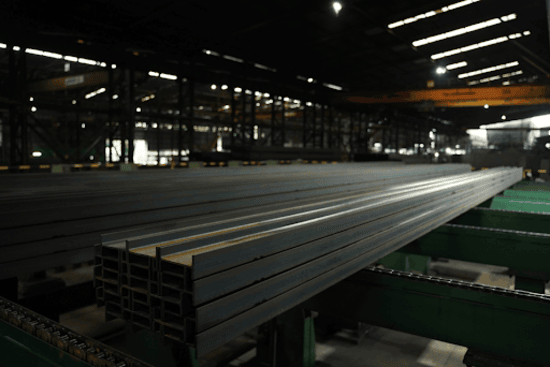
The company produces H-Beam, IWF or WF, U Channel, and Equal Angle products, categorized in the industry as structural steel or section steel because of their defined cross-sectional shapes. The term Structured Steel also appears in online searches, although structural steel remains the more widely accepted technical term. In construction, each profile has a different cross-sectional shape and function.
H-Beam and IWF can be used as beams or steel columns depending on structural calculations. Meanwhile, U Channel and Equal Angle profiles can be used for secondary framing, bracing, supports, and connection components.
For this reason, profile selection should not be based solely on nominal size. Project teams need to review H-beam sizes, flange width, web thickness, flange thickness, weight per metre, grade, and applicable product standards found in a manufacturer’s catalogue or steel profile table. Dimensional differences can affect component weight, connection details, and installation processes on site.
In its production process, GYS uses Electric Arc Furnace or EAF technology, with scrap serving as the primary raw material. The manufacturing process includes melting, refining, casting, reheating, rolling, cooling, straightening, cutting, and final inspection.
Quality control is carried out at each stage to assess chemical composition, dimensional tolerances, and the mechanical properties of the material before products are stored or distributed, supporting GYS’s range of high-quality steel profiles. Several GYS product groups hold Indonesian National Standard or SNI certification within their respective scopes, including hot-rolled steel profiles, WF Beam, H-Beam, U Channel, and Equal Angle.
In 2024 GYS also introduced GYS Tahan Gempa Plus (SN490B), a high-tensile steel with seismic-resistant properties, developed to support construction needs in regions with high seismic activity.
Offering two key advantages — more safety and cost saving — GYS Tahan Gempa Plus is designed to deliver added value through a combination of strength and material performance. For GYS, building structures is not simply about meeting construction requirements; it is about protecting what matters most: human life. Because when a structure is built to safeguard lives, safety should never be compromised.
Production capacity is also one of the factors affecting material availability. GYS has an annual production capacity of 1.2 million tonnes, with a rolling capacity of approximately 900,000 tonnes. However, this capacity does not mean that every profile type, size, or grade is continuously available. Project requirements still need to be coordinated with stock levels, production schedules, and processing lead times.
Through this facility, customers can coordinate various material processing needs, from cut-to-length services to processes such as CNC drilling, cutting, and straightening. GYS also provides standard material lengths of 6, 9, and 12 metres to accommodate different application requirements. This helps optimize material utilisation, improve fabrication efficiency, and minimise potential waste.
In addition to these services, GYS’s Steel Service Center also supports the production of T-Beams, King Cross, Queen Cross, and Honeycomb sections, providing solutions for projects with specific structural requirements.
For large-volume requirements, buyers may choose to buy steel directly from the mill, which can help align production schedules, documentation, and phased delivery. Steel suppliers with local stock remain a practical option for smaller-volume or urgent requirements. Regardless of the procurement channel, verification of the manufacturer’s identity, product marking, heat number, certificates, and physical dimensions remains necessary before the steel is used.
Buyers evaluating a steel manufacturer in Indonesia should also be cautious of unverified claims. Phrases such as the largest steel mill in Indonesia, the best steel mill in Indonesia, or a steel mill with the best quality in Indonesia are sometimes used in online searches without measurable criteria to support them, and should be weighed against documented capacity, certification, and traceability instead. Domestic steel production forms one part of the broader construction supply chain, while material selection must still follow the engineer’s design, technical specifications, and the standards applicable to each project.
Contact: 62 21 890-0222
PT Garuda Yamato Steel
Website: https://www.garudayamatosteel.com/
Email: [email protected]
Indonesia