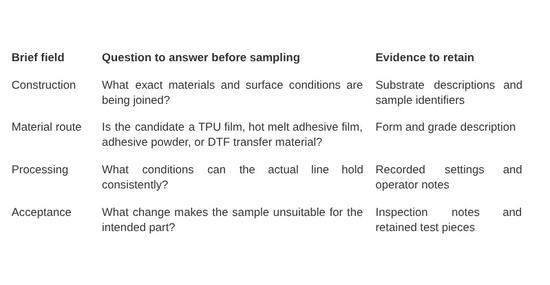
Industrial bonding samples are often compared as though the material name is the whole decision. It is not. Hot melt adhesive film and other thermoplastic systems change state during processing, and the resulting joint depends on the material, the surfaces, and the way the line brings them together. Buyers can receive several apparently relevant samples, run them once, and still be unable to explain why one result looked cleaner or held better. The missing item is usually a lamination trial brief: a compact record that tells everyone what was being joined, how it was processed, and what would count as an acceptable result.
The useful brief is not a marketing checklist. It is a common starting point for sourcing, production, quality, and the material supplier. It turns an open request such as “send an adhesive sample” into a testable question: which material form belongs in this process, on this substrate stack, under this line route? The answer may still require several trials. The benefit is that each trial produces comparable evidence instead of a collection of impressions.
Start the lamination trial with the production route
Heat-and-pressure lamination, adhesive application, and flame lamination are different process routes. Material requests should name the route before they name a preferred chemistry. Covestro’s public lamination guidance makes the same practical point: TPU films can be processed through different routes, and the route changes the relevant process conditions and substrate combinations. Lab coupons pressed between flat plates may be informative, but they are not automatically proxies for a roll laminator, a garment press, or a coating line.
Write the route in ordinary operating language. State whether the material is laid between layers, scattered over a surface, transferred from a carrier, or metered from melt-processing equipment. Record where heat is applied, when pressure arrives, how the assembly cools, and whether the line introduces tension, stretch, curvature, or a textured surface. Those details prevent an avoidable mistake: choosing a sample for its apparent chemistry while the supplied form cannot be handled reliably by the actual equipment.
Specify the substrate stack before choosing TPU film
Technical TPU film is often considered when a project needs a flexible functional layer or a lamination component. Teng Yang describes its TPU film offering as made to order for technical bonding and lamination, with grade, thickness, width, melt point, and colour among the variables a buyer can define. This makes the substrate stack the first useful piece of information in a request. “Fabric to film” is too broad; the brief should say which fabric, which side is coated or finished, what is on the other side, and which face will ultimately see wear, moisture, or cleaning.
Surface treatments deserve their own line in the record. Invisible finishes may be decisive to wetting, flow, or retention. Teams should also note whether the sample is flat, perforated, knitted, non-woven, foamed, embossed, printed, or otherwise variable. Send that construction information to Teng Yang before asking for a TPU film recommendation. This is not paperwork for its own sake. It gives the supplier a chance to identify a mismatch before material travels, and it gives the buyer a defensible way to reject a trial that does not represent the intended construction.
Match hot melt adhesive film to a named processing window
Hot melt adhesive film is a solid thermoplastic bonding layer supplied on rolls, according to Teng Yang’s current product page. The page describes activation through heat and pressure followed by solidification on cooling. That description is a reason to record the actual processing window, rather than to request a “high strength” film with no operating context. A useful trial brief names the available temperature range, the pressure method, the contact time, the cooling or dwell condition, and the line speed where that applies.
The rule is simple: use the line’s credible range, not an ideal setting remembered from a previous job. If an operator cannot hold a condition consistently, it should not be the basis for a material approval. Keep the settings in the same document as the sample code and the substrate stack. When Teng Yang hot melt adhesive film is under review, the trial record lets the team distinguish a material change from a process change if a promising result later fails at the edge, after bending, or after a wash sequence.
Keep adhesive powder and DTF transfer materials in their own trial path
Adhesive powder and DTF transfer materials should not be squeezed into a film trial simply because both are heat-activated. Teng Yang’s current site separates film, web, powder, and granules as delivery forms, and it presents DTF materials as a transfer-material system involving powder and PET film. For a powder route, the brief should identify powder application behavior, coverage, handling, and the transfer sequence. For a DTF route, it should identify the film format, the image-transfer conditions, the fabric, and the inspection points that matter to the final decorated article.
This distinction protects the trial from false comparisons. Film is placed; powder is distributed; a transfer system adds a carrier and an image process. Each path can lead to a useful bonded assembly, but each exposes a different failure mode. Powder trials might be weakened by uneven coverage. Transfer trials might look acceptable at peel but show an unwanted hand feel or incomplete release. Write those risks into the acceptance section before the sample arrives.
Use a shared acceptance record instead of a single “pass” box
One peel result, one visual check, or one successful press cycle is not a purchasing decision. The brief should define what the team will inspect immediately and what it will inspect after the conditions that matter to the application. That may include bond continuity, edge behavior, visual change, flexibility, release quality, fabric distortion, or another named requirement. It should also state which condition is disqualifying. A clear reject condition prevents a positive first impression from silently becoming production approval.
Separate supplier communication from material approval
The supplier’s role is to help turn a defined material question into a suitable sample discussion; it is not to replace the buyer’s production approval. Teng Yang says that it manages international product inquiries and project communication through its website, while the contracting company and payment beneficiary are identified on the formal quotation and pro forma invoice. That distinction is useful during sourcing: request technical guidance and quote terms in parallel, then validate the material against the buyer’s own line and acceptance criteria.
A sourcing team comparing Teng Yang materials should send the substrate stack, process route, and trial objective together. Ask the supplier to identify the proposed form and grade, explain any processing constraints, and flag missing information before dispatching samples. Keep the resulting technical response with the trial record so the person running the test can compare the recommendation with actual conditions on the line.
What a finished trial brief should make possible
At the end of the exercise, a new engineer should be able to read the record and understand why the team chose a material form, how it was processed, and what evidence supported the decision. A purchasing colleague should be able to request the same form without losing the essential conditions. A quality colleague should be able to see whether a later complaint relates to material identity, substrate variation, or a process change. If the record cannot support those handoffs, the trial was too loosely defined.
Material selection remains a trial-based decision because thermoplastic hot-melt bonds can be affected by elevated temperature and sustained loading, as the Adhesive and Sealant Council notes in its general technical overview. That is a mechanism-level limitation, not a claim about any supplier’s grade. The practical response is to make the trial brief more exact, retain the evidence, and approve only the construction that has been tested under conditions that resemble the intended use.