New survey data from 1300 Sparebox reveals what Australians really think about tiny homes, and what’s stopping them from buying one, as federal budget housing reforms and a deepening affordability crisis put alternative housing back in the spotlight.
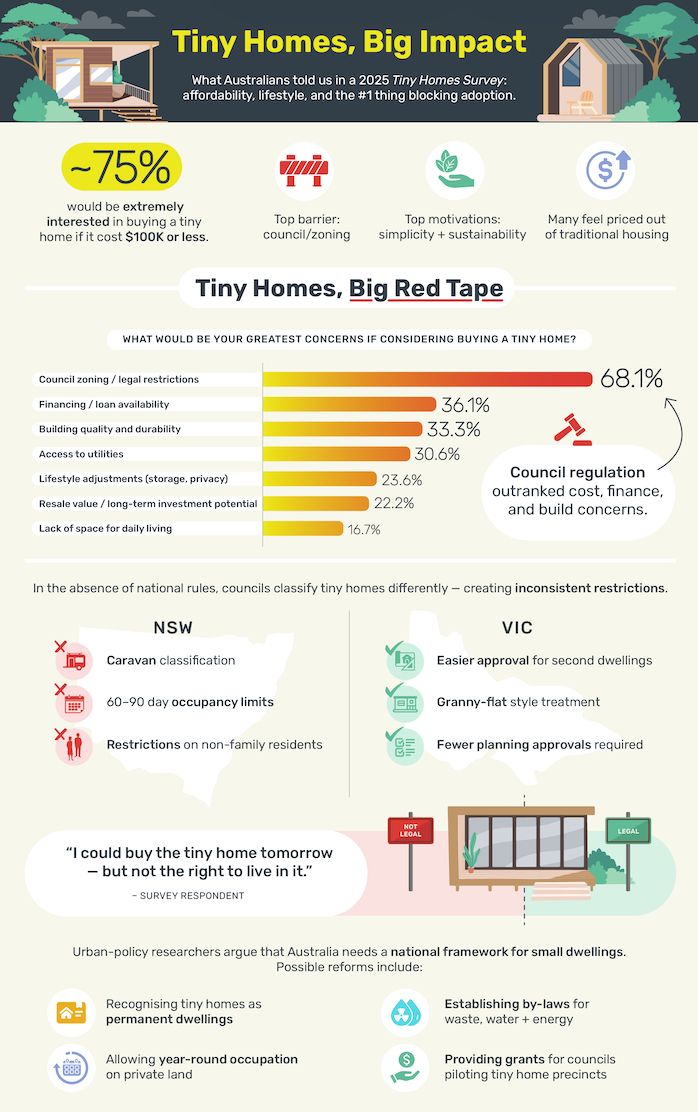
The survey found that approximately 75% of respondents would seriously consider buying a tiny home priced at $100,000 or less. With the median Australian house price exceeding $900,000, and many survey respondents reporting a borrowing capacity of $300,000 to $500,000, conventional homeownership remains out of reach for a significant portion of the population.
Recent changes to negative gearing and capital gains tax are expected to redirect investor activity toward new construction, but the near-term impact on affordability for first-time buyers is likely to be modest.
Demand Is There, Regulation Is Not
Cost is the primary attraction, with 73.2% of respondents citing low purchase price as a key motivator. However, 70.4% also pointed to a desire for a simpler, minimalist lifestyle, 54.9% highlighted lower ongoing expenses, and 39.4% named sustainability. The data suggests the tiny home movement in Australia is as much a values shift as a financial one.
Despite strong demand, 68% of survey respondents identified inconsistent council zoning and legal restrictions as the largest single barrier to buying a tiny home – outranking financing concerns (36.1%) and building quality worries (33.3%).
The research highlights a clear regulatory divide between the Australian states: New South Wales currently classifies tiny homes as caravans with occupancy limits of 60 to 90 days, while Victoria provides a comparatively more straightforward approval pathway, treating tiny homes similarly to secondary dwellings.
A Housing Solution Already Within Reach
With over 300 tiny home builders now operating across Australia, supply-side capacity exists. Purchasing shipping containers in particular have become an increasingly popular structural basis for tiny homes — with shipping container modifications allowing custom builds that are modular, durable, and available at a fraction of the cost of traditional construction materials. The survey data suggests that if regulatory barriers were resolved, a significant share of the market would move quickly: 55% of respondents reported feeling priced out of the traditional housing market entirely.
“The conversation about tiny homes in Australia has never been more relevant,” said Hannah Ballantyne, Marketing Manager at 1300 Sparebox. “Our survey data shows Australians are ready for the adoption of tiny homes. The price point works, the appetite is there, and federal housing policy is now shifting. What’s still missing is a nationwide framework that lets people actually live in a tiny home all year round.”
The research calls for national policy reform, including formal recognition of tiny homes as permanent dwellings and clear provisions for year-round occupation on private land, as Australia pursues its National Housing Accord target of 1.2 million new homes by 2030.
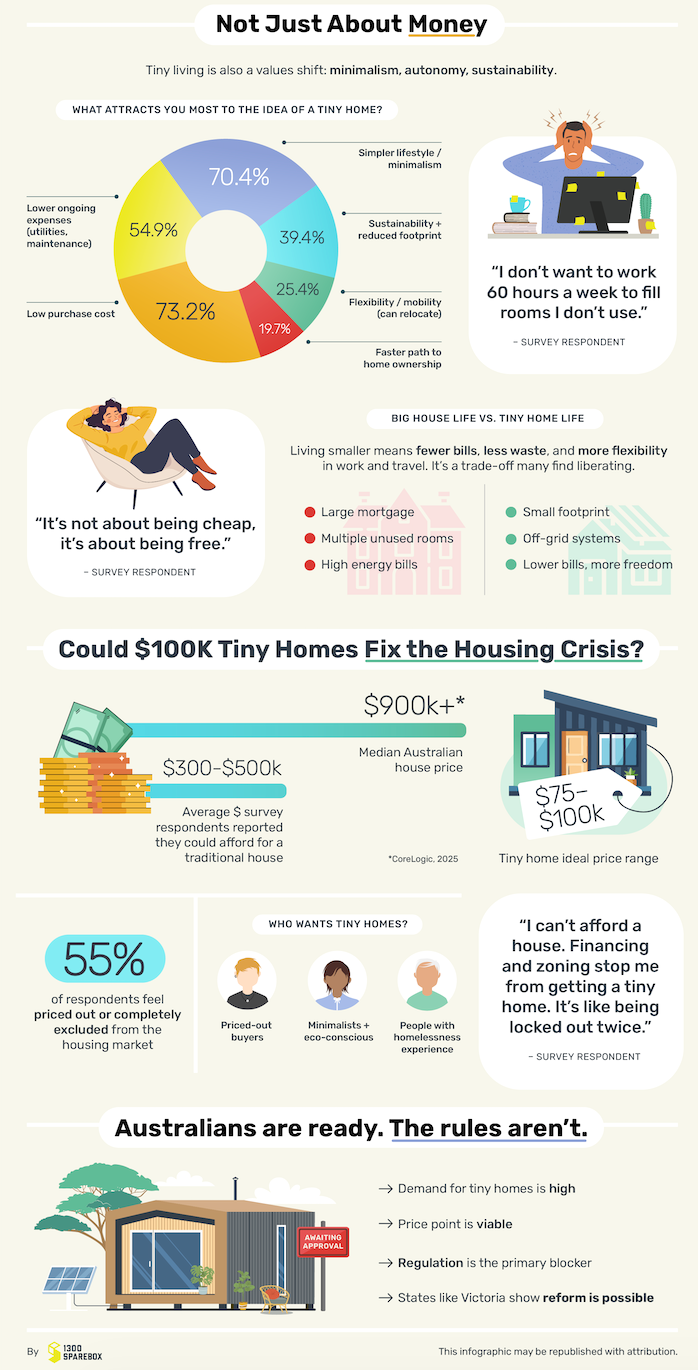
Full survey findings and the infographic are available at 1300 Sparebox Tiny Homes Research.
About 1300 Sparebox
1300 Sparebox is an Australian shipping container hire and sales company operating across Melbourne, Brisbane, and Sydney, supplying standard, refrigerated, and specialised containers for residential, commercial, construction, and events use. For more information, visit 1300sparebox.com.au.
Contact:
1300 Sparebox
Joseph Kolenda
1300 772 732
Australia