In 2024, San Diego shared the World Design Capital title with Tijuana, becoming only the second binational city pairing ever recognized by the World Design Organization: the cross-border design scene was real, the architecture was interesting, and the timing seemed right. Two years later, it’s worth asking what actually stuck.
The most visible change isn’t in the landmark buildings or the award submissions; it’s in what San Diego homeowners are asking for when they sit down with a designer. Clients are arriving with sharper references, clearer ideas, and a growing interest in European furniture makers like Poltrona Frau. The San Diego design scene is clearly changing from the fast-turnover aesthetic that defined the city’s interiors for most of the past decade. Whether the WDC title deserves any credit for that shift is another question entirely.
The End of Coastal Cliché
What’s more telling is what’s happening at the residential interior design level, away from trophy towers and award submissions. San Diego’s designers have been unusually candid lately about wanting to move past what they call the “coastal cliché”: white walls, bleached oak, linen everything… that became shorthand for Southern California living. After years of black windows and gray floors, designers and clients alike are returning to organic textures, saturated color, and materials that accumulate character over time rather than dating quickly.
What Homeowners Are Actually Buying Now
In the two years since, local homeowners have moved away from the generic minimal-coastal template that dominated residential interiors across the county for most of the previous decade: open floor plans are giving way to more considered spatial sequences, the “millennial gray” palette is being replaced by warmer, more grounded tones such as clay, olive, warm brown and natural stone with dramatic veining.
That change in intention is also showing up in furniture choices. Pieces that carry a clear design lineage are appearing in residential projects that would have defaulted to contract-grade alternatives five years ago: B&B Italia’s modular seating systems like the Dambo Sofa and the Bend Sofa, Cassina’s reissued mid-century classics such as the Utrecht Armchair or the Cab 413 Chair, Giorgetti’s solid walnut case goods like the Romeo Coffee Table or the Kukei Sideboard. The calculus has shifted: when a homeowner plans to stay in a property for fifteen to twenty years, the argument for a considered, authorial piece becomes easier to make than the argument for a replaceable one.
The Outdoors as the Primary Space
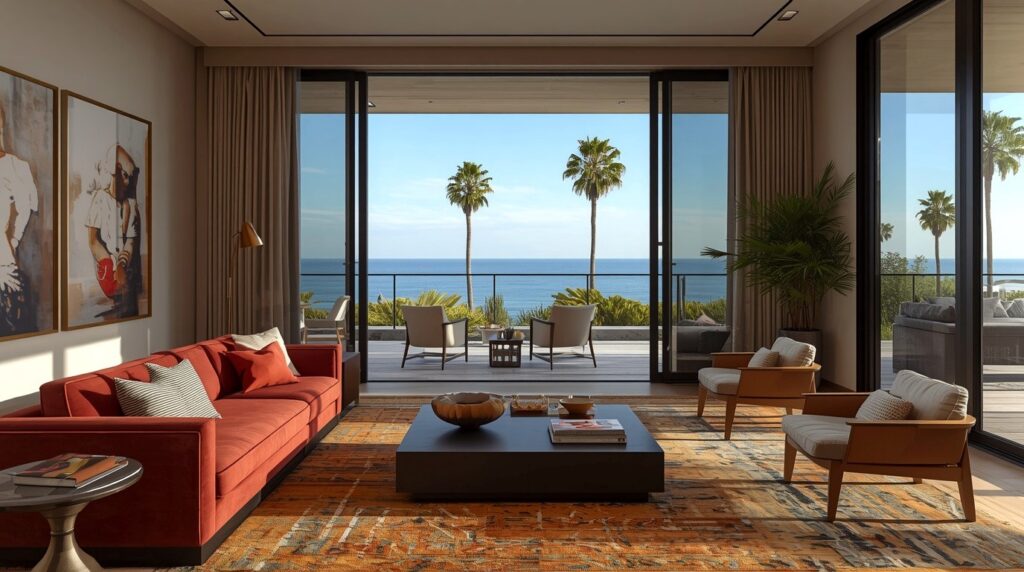
The other area where San Diego’s design culture is genuinely evolving is the indoor-outdoor relationship, and here, the World Design Capital framing actually helps. The binational designation forced a conversation about what is specific to this place: the climate, the light, the landscape. When outdoor living runs ten to eleven months a year, the interior stops being the primary space in any meaningful sense, and the furniture and material logic have to follow.
Homeowners are now investing in outdoor environments that function as genuine extensions of the home: covered structures with integrated lighting, retractable glass walls, and flooring that transitions seamlessly between inside and out. Brands like Kettal and Paola Lenti, which build outdoor collections with the material rigor usually associated with interior furniture, have found a receptive market here precisely because the demand for that kind of quality has finally caught up with the climate.
San Diego earned its World Design Capital title on the strength of something real. Two years later, the residential interior scene is moving. Slowly, unevenly, but with more intentionality than before.