Bangkok, Thailand — On February 26–27, 2026, the Practical Anti-Aging Symposium 2026 was held in Bangkok as an academic forum focused on anti-aging medicine, preventive care, and longevity science. The event brought together physicians and health experts to exchange knowledge on advanced health optimization, emerging medical technologies, and the biological mechanisms that influence aging.
Dr. Tanaporn Eiamprapai, MD, attended the symposium on behalf of R3 Life to review current scientific discussions in longevity medicine and cellular health. One key topic highlighted during the academic exchange was the “Hallmarks of Aging,” a scientific framework used to explain the biological processes that contribute to age-related decline.
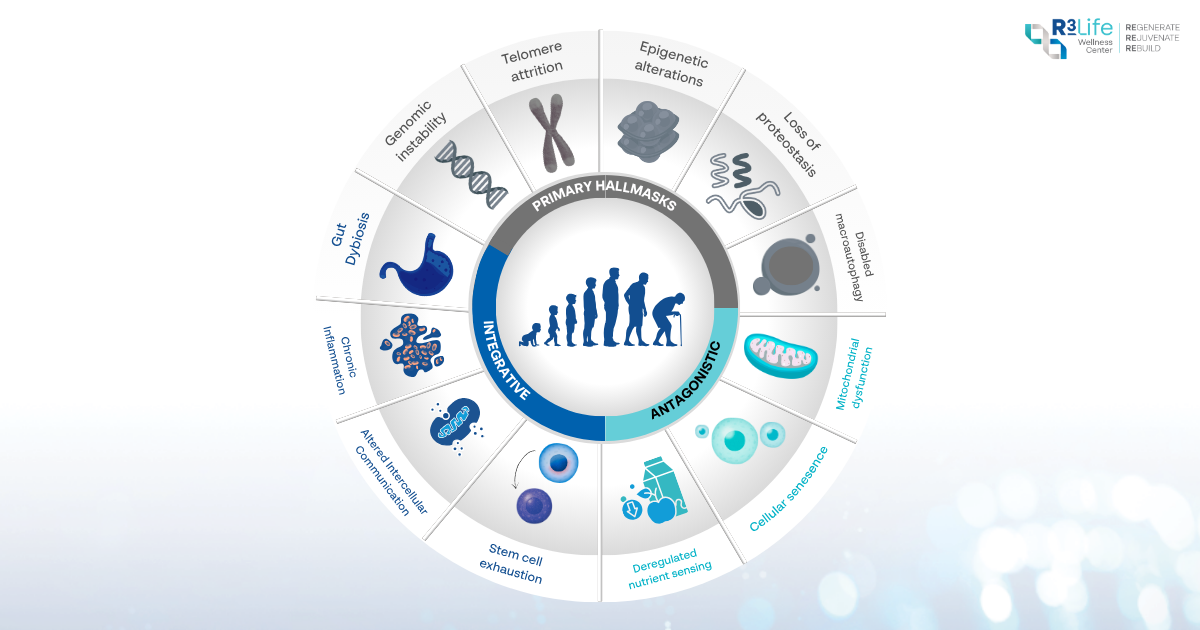
First introduced in Cell in 2013 and updated in 2023, the Hallmarks of Aging framework identifies 12 biological hallmarks that help explain aging as an accumulation of cellular and molecular changes. These changes may affect organ function, metabolic balance, tissue repair, immune response, and long-term health.
Hallmarks of Aging Framework
The Hallmarks of Aging are commonly grouped into three major categories. The first category, primary hallmarks, refers to early biological damage. These include genomic instability, telomere attrition, epigenetic alterations, loss of proteostasis, and disabled macroautophagy. These processes involve DNA damage, telomere shortening, unstable gene regulation, and reduced ability to clear damaged proteins and cellular components.
The second category, antagonistic hallmarks, includes protective mechanisms that may become harmful when chronically activated. These include deregulated nutrient sensing, mitochondrial dysfunction, and cellular senescence. Pathways such as mTOR, AMPK, insulin, and IGF-1 influence the balance between growth, repair, and energy use. When these pathways become dysregulated, cells may produce less energy, generate more oxidative stress, or enter senescence.
Senescent cells no longer divide, but they may continue releasing inflammatory signals. This process is associated with chronic low-grade inflammation, which is increasingly recognized in longevity medicine as a factor linked to age-related decline.
The third category, integrative hallmarks, appears when repair and communication systems begin to fail. These include stem cell exhaustion, altered intercellular communication, chronic inflammation, and dysbiosis. At this stage, aging may become visible through reduced tissue repair, weakened immunity, hormonal changes, gut imbalance, and declining organ function.
The Hallmarks of Aging framework helps connect cellular changes with clinical conditions. In vascular aging, mitochondrial dysfunction, reduced nitric oxide, telomere shortening, and inflammation may contribute to endothelial dysfunction, arterial stiffness, and cardiovascular risk.
In metabolic and liver aging, nutrient-sensing imbalance, reduced autophagy, lipotoxicity, and inflammation may contribute to fatty liver disease and metabolic syndrome. In muscle aging, stem cell exhaustion and mitochondrial decline may reduce muscle repair, ATP production, and VO₂ max, increasing the risk of sarcopenia and frailty.
In brain aging, impaired autophagy, misfolded proteins, neuroinflammation, and reduced cerebral perfusion may be associated with cognitive decline and neurodegenerative disease risk.
The framework also helps distinguish lifespan, healthspan, and peakspan. Lifespan refers to total years lived. Healthspan refers to the period spent free from chronic disease. Peakspan refers to the period when the body and brain maintain high performance. Longevity medicine increasingly focuses on preserving function, resilience, and quality of life rather than only extending lifespan.
Personalized Prevention Across Life Stages
Because aging patterns vary across life stages, prevention strategies are often personalized. In early life, the focus may include healthy epigenetic programming, mitochondrial health, and metabolic balance. In young adulthood, prevention may involve maintaining muscle mass, optimizing sleep, controlling visceral fat, and reducing chronic inflammation.
During midlife, usually between ages 40 and 60, attention often shifts toward detection and early intervention. This may include advanced biomarker testing, telomere assessment, metabolic evaluation, vascular risk screening, and inflammation monitoring. In older age, the emphasis may move toward preservation and resilience, including muscle strength, cognitive support, vascular stability, and regenerative capacity.
Telomeres and Stem Cell Health
Telomeres are one measurable marker within the Hallmarks of Aging framework. They are protective DNA sequences at the ends of chromosomes that shorten with each cell division. When telomeres become critically short, cells may enter senescence. Telomere shortening may be accelerated by oxidative stress, chronic inflammation, insulin resistance, type 2 diabetes, psychological stress, smoking, and toxin exposure.
Telomere length is not the only marker of biological age. However, when evaluated alongside inflammatory markers, metabolic health, vascular function, and muscle reserve, it may provide useful insight into biological aging patterns.
Stem cell health is also closely connected to aging biology. As the stem cell niche deteriorates, regenerative capacity may decline. Mesenchymal stem cells are being studied for their role in supporting the cellular microenvironment, modulating inflammation, reducing oxidative stress, and supporting tissue repair. Stem cell therapy should be clinically evaluated and personalized, rather than viewed as a universal solution.
Lifestyle Factors Linked to Aging Biology
Several lifestyle and environmental factors may accelerate cellular aging. These include visceral fat, insulin resistance, poor sleep, circadian disruption, inactivity, muscle loss, chronic stress, smoking, toxic exposures, and excessive alcohol consumption. These factors may increase inflammation, worsen mitochondrial function, and contribute to cellular senescence.
The Hallmarks of Aging provide a scientific map for understanding biological decline at the cellular level. By assessing telomere length, inflammatory burden, metabolic resilience, muscle reserve, and vascular markers, longevity medicine is moving toward earlier identification of aging-related risk factors and more personalized health strategies.
R3 Life continues to follow developments in anti-aging and preventive medicine, with attention to evidence-based approaches that support cellular health, resilience, and long-term wellness.
Business: R3 Life Wellness Center
Contact Name: R3 Life Wellness Center
Contact Email: [email protected]
Contact Phone: +66 88 689 8888
Website URL: https://r3lifewellness.com/en
Address: No.42, ICP Building, 4th Floor, Surawong Road, Si Phraya Subdistrict, Bang Rak District, Bangkok 10500
Country: Thailand