Execution capability is, amidst the current disruptions, the crucial lever for a company’s success. Long strategy meetings produce impressive presentations; after passionate and even controversial discussions, however, everyone eventually gives it the thumbs-up: “Yes – that’s how we will make it happen.” In training sessions, managers are then further committed to the cause and equipped with the necessary skills. But then the daily routine once again prioritizes the urgent over the important; simply too little happens; momentum is lost; commitments made are forgotten or watered down; and there is a lack of decisive and goal-oriented action. This isn’t necessarily down to ill will – it’s just human nature.
This “knowing-doing gap” can currently be seen not only in the world of high-level politics. A recent survey of around 250 German companies shows how, unfortunately, many companies are feeling: 70% report only minimal to sporadic implementation in practice – 20% have no data on this at all, while only 10% are “somewhat satisfied” with the transfer.
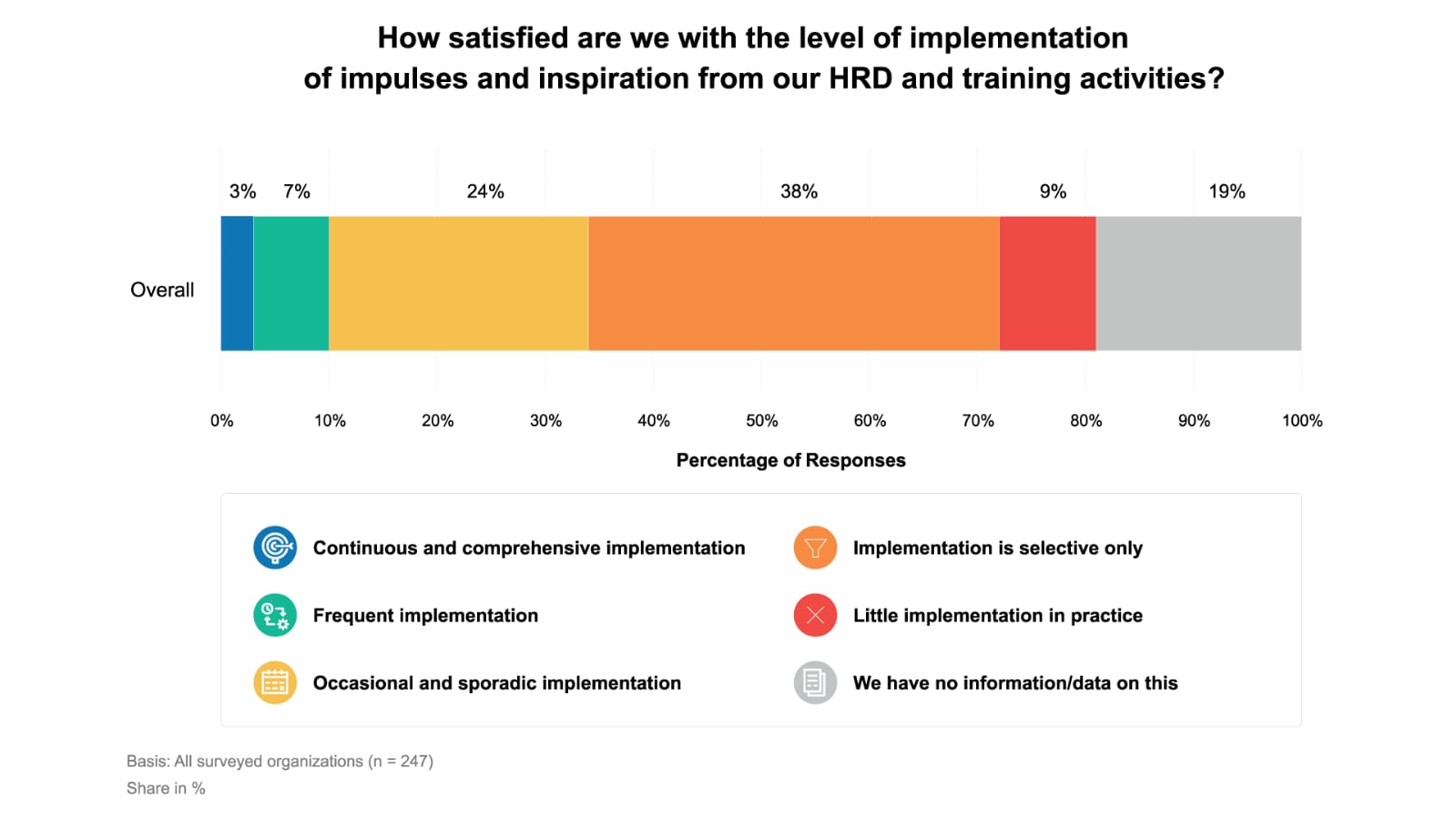
Significant investments are being made in important and worthwhile initiatives that implement strategy and “learning journeys” – yet, unfortunately, their impact in practice all too often fizzles out too quickly. There is a lack of continuous impetus to stay on track – to really get down to “doing”.
With the support of artificial intelligence, what a company has already implemented (and invested in!) in terms of strategic direction and improved leadership can finally be made to deliver continuous, tangible results: through AI-powered “nudging” – an approach based on the work of Nobel laureate Richard H. Thaler. Nudging means continuously “giving a nudge” to actually take action – and make things happen. It’s similar to the reminder “beep” anyone hears when a seatbelt has not been fastened in the car. What makes this special is that it requires no additional training measures; instead, investments already made in strategy and leadership are, so to speak, “recycled” – tailored to the specific company and personalized individually for each leader – аnd integrаted into a communication system that is already in daily use. The principle is impressively simple and requires no additional IT project. Thanks to “Blended Leading”, this new approach is now finally available at scale and at minimal cost.
And companies can even try it out free of charge until the end of the year, as this scientifically sound project was funded by the European Union. More information is available in the detailed white paper at https://l.ls-s.com/wp-en.