Wealth management has spent years asking what artificial intelligence can realistically do when given full control of an investment portfolio. FINQ now has a live answer, and the early data is difficult to ignore.
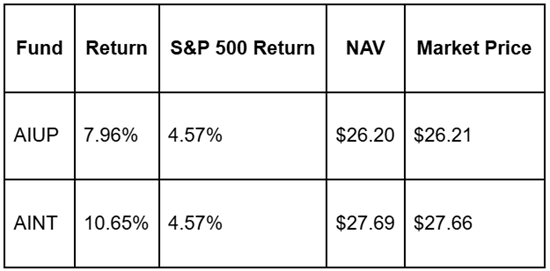
The firm launched two ETFs on NYSE Arca on February 5, 2026, both managed entirely by its proprietary AI framework. From that date through April 30, 2026, AIUP returned 7.96% and AINT returned 10.65%, both outperforming the S&P 500, which returned 4.57% over the same period. FINQ describes both as the first SEC-registered U.S. ETFs in which stock selection, position weighting, and rebalancing are conducted without human portfolio management.
Different Funds, Different Strategies
AIUP and AINT are built for different investor objectives, and understanding the distinction matters before evaluating their results.
AIUP, the FINQ FIRST U.S. Large Cap AI-Managed Equity ETF, is a long equity fund. It holds U.S. large-cap stocks selected, weighted, and rebalanced by FINQ’s proprietary AI. Its gross expense ratio is 0.70%.
AINT, the FINQ Dollar Neutral U.S. Large Cap AI-Managed Equity ETF, is a more complex vehicle. It holds long and short positions simultaneously in a dollar-neutral structure, seeking to profit from the relative performance between the securities it buys and those it shorts. It does not rely on the market moving in any particular direction to generate returns. Its gross expense ratio is 1.25%.
FINQ, which operates in both the United States and Israel, developed the AI system that manages both funds. The company positions itself as a wealth-tech firm with a mission to democratize access to sophisticated investment strategies through autonomous AI, making institutional-grade portfolio management available to a broader range of investors than has historically had access to it.
The Numbers
A New Standard for Active Management
The opening quarter results position FINQ’s AI framework as a capable and autonomous portfolio manager. AIUP outperformed the S&P 500 by approximately 3.4 percentage points. AINT outperformed it by more than six. Both funds operated entirely without human intervention, with the AI making every selection, weighting, and rebalancing decision across the period.
What makes these results particularly meaningful is the context in which they were produced. AIUP and AINT are not back-tested models or paper portfolios. They are live, SEC-registered funds that traded on NYSE Arca from day one, with real capital allocated according to the AI’s decisions. The outperformance figures in the table above reflect actual market execution, not simulation.
FINQ publishes full standardized performance data, portfolio holdings, and benchmark comparisons on the AIUP and AINT fund pages, giving investors the transparency to evaluate the AI’s decision-making as the platform grows and market conditions evolve.
FINQ’s Larger Ambition
“We are happy to lead the next generation of AI-managed investments, with the introduction of our first two ETFs to be followed by many more products and services, creating a leading wealth-management company based on AI,” says Eldad Tamir, founder and CEO of FINQ.
The company’s ambition extends well beyond two funds. Tamir’s comments point to a full AI-based wealth management platform in development, with AIUP and AINT serving as the proof of concept on which that platform is being built. For investors, that means a growing suite of AI-managed products is likely to follow, each drawing on the same autonomous framework that produced the opening quarter results.
What FINQ has established is that autonomous AI can manage registered investment vehicles, satisfy SEC requirements, trade on a major exchange, and outperform the market’s benchmark index in its opening period. That is a meaningful set of facts for an industry that has long debated the role AI could realistically play at the center of portfolio management. FINQ has moved that debate from theory to practice.