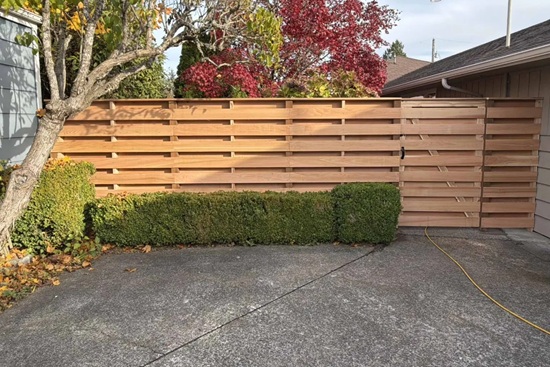
Every fence has a lifespan. In Bellevue, that lifespan is shorter than it would be in a dry climate — the Pacific Northwest’s eight-month wet season, persistent humidity, and biological pressure from rot fungi and moss accelerate degradation in ways that homeowners moving from drier parts of the country are often surprised by. A cedar fence that might last 30 years in Colorado may be significantly compromised at 15 in Bellevue.
Fence replacement in Bellevue, WA becomes the right answer when the accumulation of moisture damage, structural rot, and maintenance costs outpaces what targeted repairs can address. Knowing when that point is reached — and how to approach a full replacement intelligently — prevents homeowners from spending repair money on a fence that’s already at end-of-life.
The Signs That a Bellevue Fence Needs Full Replacement
Multiple Posts with Base Rot
Single post replacement is a repair. Multiple posts with rot at the base is a pattern that signals the fence is at the end of its structural life. In Bellevue’s wet soil conditions — particularly in Kirkland, Redmond, and Sammamish where clay soils hold moisture at grade level continuously — fence posts set without ground-contact pressure treatment rot at predictable intervals.
When the third or fourth post in a fence run probes soft at the base, the cost of individual post replacements across the full fence often approaches or exceeds replacement cost while delivering a fence with inconsistent structural condition. Multiple simultaneous post failures are the clearest replacement indicator.
Systemic Rail and Board Rot
Isolated board rot in one section is a repair. Rail rot and board deterioration distributed across most of the fence’s length is systemic failure. This pattern develops when the fence was never properly sealed, when maintenance was deferred for several wet seasons, or when the original material quality was inadequate for Bellevue’s conditions.
The visual test: walk the fence line and probe rails and boards at regular intervals with a screwdriver. If the soft areas are frequent and spread across multiple sections rather than isolated to one location, the fence is systemically compromised and repair is a diminishing-returns exercise.
Structural Instability That Isn’t Post-Specific
A fence that moves visibly when pushed — panels that flex, rails that wobble, sections that lean without obvious single-point failure — has structural deterioration distributed through the framework. In Bellevue’s older neighborhoods, particularly homes built in the 1980s and 1990s that are now in the 30-to-40-year age range, fences built at that era are reaching exactly this condition.
Structural instability isn’t always dramatic. A fence that shifts 6 inches in the wind and returns to approximately level looks fine in a photograph. The movement is what matters — it indicates the fence system is no longer providing the boundary definition and security it was installed for.
The Right Approach to Fence Replacement in Bellevue
Assessment Before Demolition
The replacement decision is also the redesign opportunity. A full fence replacement is the right time to correct problems in the original installation — inadequate post depth, no post caps, undersized rails, fasteners that rust — and to upgrade material quality where the budget allows.
Before demolition, a professional assessment of the existing fence documents what failed and why. Identifying the failure mode — post rot from inadequate treatment, rail rot from no water-shedding detail, systemic board rot from deferred maintenance — informs the specification choices for the replacement.
Choosing Replacement Material Based on Lessons Learned
Homeowners replacing a failed wood fence have the option to stay with wood and do it right this time, or to switch to a lower-maintenance material. Bellevue homeowners who have managed one or two cedar fence cycles and find the maintenance burden incompatible with their lifestyle often switch to vinyl for its genuinely low maintenance profile. Homeowners who value the natural wood aesthetic and are committed to the maintenance cycle can get much longer life from their next cedar fence by specifying better grades and installation details.
The replacement is the opportunity to solve the underlying problem rather than rebuild the same fence and get the same outcome.
Permits for Fence Replacement in Bellevue
Full fence replacement in Bellevue generally doesn’t require a building permit if the replacement is like-for-like — same height, same location. Changes to fence height, location relative to property lines, or the addition of a new fence where none existed may require permit review. Confirming with the City of Bellevue permitting department or with your contractor is the right first step before the old fence comes down.
Property line confirmation matters when replacing a fence along a shared boundary — confirming the actual property line location before setting new posts prevents boundary disputes with neighbors in Kirkland, Redmond, or Sammamish properties where lot line assumptions may be off.
What Bellevue Fence Replacement Costs and What It Delivers
A replacement cedar privacy fence in Bellevue, properly specified with pressure-treated posts, clear heart cedar boards, sealed hardware, and proper installation details, costs more than the bare-minimum installation it’s replacing. It should. The difference in specification is what delivers a fence that reaches 20 to 25 years in Bellevue’s conditions rather than failing at 12.
Optima Fence and Deck handles fence replacement and repair in Bellevue and throughout the Eastside — Kirkland, Redmond, and Issaquah — with inspection-based assessments that give homeowners accurate information about when repair is still the right call and when replacement delivers better long-term value. A fence that’s replaced with the right specification for Bellevue’s climate is the last fence you should need for 20-plus years.
Frequently Asked Questions
How do I know if my Bellevue fence needs replacement vs. repair?
The key indicator is how widespread the deterioration is. Isolated damage to one or two posts or a single fence section is repair territory. Multiple posts with base rot, systemic rail and board deterioration throughout the fence, or structural instability that isn’t traced to a single point all indicate replacement is more cost-effective than ongoing repair. A professional probe inspection of all structural members gives you accurate information rather than a surface assessment.
How long should a wood fence last in Bellevue, WA?
A properly installed cedar fence with ground-contact pressure-treated posts, quality cedar boards, proper hardware, and consistent maintenance should last 20 to 25 years in Bellevue. Without maintenance, 10 to 15 years is a more realistic expectation in PNW conditions. Fences built with untreated posts or low-grade lumber in Bellevue’s wet climate may fail structurally within 8 to 12 years.
What happens to old fence material after replacement in Bellevue?
Contractors typically haul away and dispose of demolished fence material as part of the replacement project. Cedar fence material that’s in reasonable condition can sometimes be repurposed for raised garden beds or other outdoor structures. Treated lumber waste needs to be handled as treated wood — it can’t go into residential compost or burning piles. Your contractor should confirm disposal approach, particularly for treated wood components.
Can I replace my fence myself in Bellevue?
DIY fence replacement is feasible for capable homeowners — post setting, rail installation, and board attachment are skills learnable from instruction. The challenges in Bellevue are post hole digging in rocky or root-compacted soils common in Sammamish and Issaquah hillside properties, ensuring posts are level and aligned across the full fence run, and properly disposing of treated lumber waste. Professional installation produces better alignment and delivers work faster, particularly for longer fence runs.
Does replacing a wood fence with vinyl require a permit in Bellevue, WA?
Generally no, if the replacement fence is the same height and in the same location as the existing fence. Changing from wood to vinyl is a material change that doesn’t typically trigger permit requirements in Bellevue’s residential zones. Changes to height, location, or the addition of fence where none existed are more likely to require permits. Confirming with the City of Bellevue or your contractor before starting demo is always a good practice.