
For decades, the press release distribution industry has relied on a familiar collection of metrics to demonstrate campaign performance:
- Media pickups
- Potential audience reach
- Estimated impressions
- Referral traffic
- Website visits
- Social engagement
- Advertising Value Equivalency
These figures became standard because they gave communications teams, agencies, and clients a practical way to document what happened after an announcement was released.
There is nothing inherently wrong with them.
Media pickups confirm that content was distributed. Potential reach indicates the size of the audience that might encounter it. Traffic can show that people took enough interest to visit the organization’s website.
These metrics were developed for a digital environment in which visibility was largely defined by publication, circulation, and exposure.
The problem is not that the PR industry chose the wrong metrics.
The problem is that the digital world evolved far more quickly than the way PR performance was commonly assessed.
Search engines moved beyond matching keywords. They became better at interpreting intent, context, entities, authority, and relationships.
Consumer research moved beyond visiting websites and comparing links.
Artificial intelligence introduced a new discovery layer through which people can ask direct questions, compare companies, evaluate products, and receive synthesized answers without beginning with a traditional search-results page.
The information environment changed.
PR reporting changed much more slowly.
Artificial intelligence did not create that gap.
It exposed it.
The Question Every PR Professional Eventually Encounters
Every experienced PR professional eventually reaches the same moment.
The campaign is complete.
The announcement has been distributed.
The reporting dashboard is ready.
It may show hundreds of media pickups, millions of potential readers, backlinks, referral traffic, and social activity.
On paper, the campaign appears successful.
Then comes the question that is much harder to answer:
What actually changed?
Did customers better understand the company?
Did investors gain confidence in its direction?
Did journalists become more familiar with its expertise?
Did the organization’s market position become clearer?
Did its reputation improve?
Did the campaign make the business easier to discover?
Most importantly, did the public information surrounding the organization become more accurate, complete, and useful?
Traditional PR reports can explain where content appeared.
They struggle to explain what that content changed.
That distinction matters because reporting activity and measuring impact are not the same thing.
Reporting Tells Us What Happened. Impact Tells Us What Changed.
A media pickup proves publication.
It does not prove understanding.
Potential reach estimates an opportunity to be seen.
It does not confirm that the right audience encountered the announcement.
Referral traffic records visits.
It does not tell us whether a journalist gained useful context, an investor became more confident, or a future customer considered the organization more credible.
The Press Release Distribution industry has become highly effective at documenting the output of communications activity.
The harder task has always been connecting that output to longer-term business outcomes.
This is not a new concern. The communications measurement profession has spent years encouraging practitioners to distinguish outputs—the content and activity produced—from outcomes such as changes in awareness, attitudes, beliefs, and behavior. The Barcelona Principles 3.0 formalized this distinction and emphasized the need to measure impact rather than rely only on easily reported activity.
AI has not invalidated those principles.
It has made the need for them more visible.
Why Traditional Metrics Made Sense
It would be unfair to look at older PR measurement methods through the lens of today’s technology and conclude that the industry had been wrong all along.
The press release industry predates the modern commercial internet by decades.
Search engine optimization emerged much later. The term SEO began entering professional use during the 1990s, as businesses started adapting their content to the way search engines found and ranked webpages.
Artificial intelligence, as businesses and consumers experience it today, arrived later still.
These industries did not replace one another.
They became layers of the same information ecosystem.
Press release distribution created broad publication and third-party visibility.
Search engines made that published information discoverable.
AI assistants now retrieve, interpret, compare, and synthesize information found across those same digital sources.
Traditional PR metrics made sense when the central question was:
How widely was this announcement distributed?
Today, that question remains relevant.
It is simply no longer sufficient by itself.
The digital ecosystem now asks an additional question:
How effectively can the announcement be found, interpreted, and connected to the organization behind it?
The Digital World Changed. Distribution Did Not Become Obsolete.
Search evolved from keyword matching toward semantic interpretation, entity recognition, natural-language understanding, and contextual relevance.
Consumers changed how they conduct research.
Journalists gained access to larger and faster research tools.
Investors began evaluating companies across websites, databases, search results, media coverage, executive profiles, and public announcements.
AI assistants then introduced a new interface.
Instead of asking users to examine a list of links, these systems attempt to produce an answer.
That answer may include:
- A company description
- A product comparison
- A list of recommended providers
- A summary of recent developments
- An explanation of an industry
- An assessment of a company’s leadership or positioning
This shift does not make traditional press release distribution less valuable.
In many respects, it makes trusted third-party publication more important.
A placement on an established financial, business, technology, or industry publication still gives an announcement the opportunity to reach readers directly.
It may also become searchable.
It may provide background for journalists.
It may support investor or customer research.
It may become one of the external sources from which AI systems retrieve and corroborate information.
The same publication can now serve several discovery environments at once.
Distribution remains the infrastructure.
What has changed is the number and nature of the systems consuming the information flowing through it.
The Market Has Already Moved
The role of AI in product discovery and corporate research is no longer theoretical.
Similarweb reported that 35% of U.S. consumers use AI during the product-discovery stage, compared with 13.6% who begin with traditional search. Its analysis suggests that many potential buyers are beginning to form their shortlists inside AI-generated answers before opening a conventional search-results page.
This does not mean search engines are disappearing.
It means the discovery journey is becoming more complex.
A person may begin with an AI assistant, move to Google, review a company’s website, read third-party coverage, check executive profiles, and return to an AI platform for comparison.
The boundaries between PR, search, content, and AI discovery are therefore becoming less distinct.
Muck Rack’s research provides another important signal. Its more recent analysis of millions of AI-cited links found that earned media accounts for approximately 84% of AI citations, while paid and advertorial content represents only a very small share. Earlier editions of its research likewise found that AI systems rely heavily on non-paid and journalistic sources.
That finding should not be interpreted as evidence that AI has replaced PR.
It suggests almost the opposite.
The third-party credibility that public relations has always worked to establish remains highly relevant when AI systems assemble answers.
Earned and independently published information can help establish what an organization is, what it does, who leads it, which market it serves, and how external sources describe it.
AI is not creating a parallel PR distribution network.
It is drawing from the information already available through the existing media and digital ecosystem.
AI Is Not Another Distribution Network
This misunderstanding is becoming increasingly common.
Some organizations treat AI assistants as if they were a new set of publications on which a press release could be placed.
They are not.
ChatGPT, Gemini, Claude, Perplexity, and similar systems do not function as conventional press release distribution endpoints.
They interpret information drawn from sources available to them.
Those sources may include:
- Established media publications
- Industry websites
- Financial news platforms
- Company websites
- Research reports
- Databases
- Public records
- Product documentation
- Reviews and community discussions
AI does not replace the distribution layer.
It sits within the discovery layer.
A simplified view looks like this:
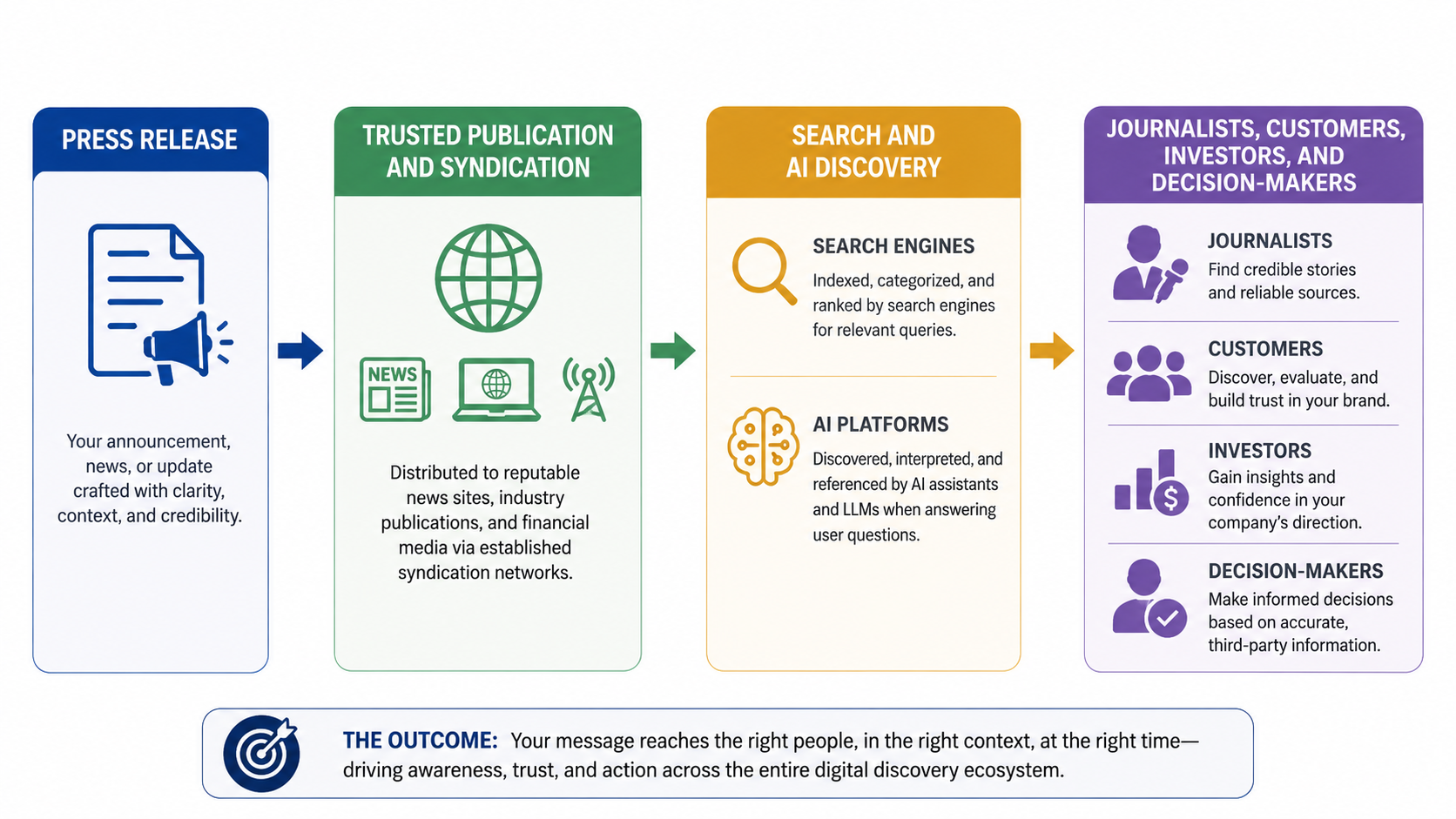
The distribution infrastructure still performs the essential task of placing information into credible and accessible environments.
AI then becomes one of several systems capable of finding and interpreting it.
This is why publishing on one major website and calling it a complete PR strategy creates unnecessary concentration risk.
A single placement may be prestigious and valuable.
But it remains one source on one domain under one publisher’s policies.
Search indexing can change.
Publisher structures can change.
Content archives can change.
Algorithms can change.
Even a large and attractive basket can eventually break.
A resilient PR strategy gives the story multiple opportunities to be discovered across relevant, credible, and independent sources.
The Solution Is Not to Dismantle Distribution
Press releases are commonly transmitted through feeds and syndication systems that send content to third-party publishers.
Once a release appears on a publication such as a financial news platform, the distributor generally does not control that publisher’s page architecture, analytics configuration, or tracking environment.
A newswire cannot reasonably expect every independent publisher to allow each distribution provider to install separate tracking scripts, cookies, or proprietary reporting code on syndicated pages.
Those are practical infrastructure limitations.
They do not necessarily indicate that distribution failed.
A placement on a major publication still creates a genuine opportunity for visibility, even when the precise number of readers attributable to that one placement cannot be independently confirmed by the distributor.
The problem occurs when potential exposure is treated as a complete PR strategy rather than one component of it.
A high-traffic publication offers access to a large possible audience.
A broad distribution network creates multiple discovery points.
A search-visible release can continue appearing after the initial publication date.
An AI-readable release can reinforce how a company is described in answer engines.
These benefits complement one another.
The solution is therefore not to discard proven distribution infrastructure.
It is to improve the quality of the information being distributed through it.
A Well-Written Press Release Can Still Perform Through Existing Distribution
In my experience, a properly written press release will usually outperform a weak one even when both use the same distribution network.
That may sound obvious, but it has important implications.
Distribution determines where the information can appear.
Writing determines what the information communicates once it arrives.
A weak release may still achieve pickup.
It may still appear on established publications.
It may still be indexed.
But if it contains vague positioning, inconsistent company descriptions, unclear attribution, keyword-heavy language, or poorly explained relationships, publication alone cannot repair those weaknesses.
The modern press release must work for several audiences simultaneously:
- Journalists looking for a credible story
- Customers trying to understand the business
- Investors evaluating context and direction
- Search engines interpreting relevance and entities
- AI systems attempting to synthesize accurate answers
This does not require abandoning traditional press release writing.
It requires strengthening it.
The Announcement Provides the News. The Entity Provides the Context.
Traditional press releases are often organized almost entirely around the announcement.
A product launch.
A funding round.
A partnership.
An acquisition.
An executive appointment.
The announcement is important, but AI and modern search systems also need to understand the entity behind it.
Who issued the announcement?
What does the company do?
Which industry does it serve?
Who leads it?
What is the product or service being discussed?
How is that product connected to the company?
Which market, location, technology, or category is relevant?
How consistently is the company described across other reliable sources?
The news provides the update.
The entity gives that update meaning.
This is why entity-centric writing is becoming increasingly important.
A release should not force readers—or machines—to infer the identity and relevance of the organization from scattered promotional language.
It should establish the issuer clearly and early.
It should define the company using consistent terminology.
It should identify the people, products, locations, and organizations involved.
It should explain the relationships between them.
It should make clear who is speaking, what authority that person has, and why the statement matters.
AI builds context around entities, not around disconnected announcements.
The clearer the entity, the easier it becomes to understand the news.
Keywords Are Losing Ground to Intent and Context
Keywords will not disappear.
They remain useful signals that help establish subject matter.
But keyword repetition is becoming a weaker substitute for genuine clarity.
A release can repeat “enterprise AI platform” several times without explaining:
- Who the platform is for
- What business problem it addresses
- What information it uses
- How it differs from alternatives
- Which organization operates it
- Why the announcement matters now
Modern discovery systems increasingly attempt to interpret meaning rather than count matching phrases.
That makes intent and context more important.
An entity-centric press release should therefore focus less on inserting isolated keywords and more on answering the questions that establish understanding:
- Who is involved?
- What happened?
- Why does it matter?
- Where does it apply?
- How are the entities connected?
- What supporting facts establish credibility?
- What has changed as a result?
This approach is not “writing for robots.”
It is writing more clearly.
The same elements that help AI interpret a release also help journalists, customers, and investors understand it faster.
What an AI-Ready Press Release Should Do
An effective press release for the AI era should retain traditional editorial discipline while improving contextual completeness.
It should:
Identify the issuer immediately
The company or organization behind the announcement should be unambiguous.
Define the entity consistently
The release should use stable descriptions of the company, its products, its leadership, and its market category.
Establish relationships clearly
Executives should be connected to their roles. Products should be connected to the company. Partnerships should explain the participating organizations and their respective responsibilities.
Provide verifiable facts
Specific dates, locations, figures, milestones, and supporting details make the announcement more useful and credible.
Use quotes to add information
Executive quotations should contribute perspective, explanation, or strategic context rather than repeat promotional claims.
Explain why the announcement matters
The release should connect the news to a customer problem, industry trend, market need, or organizational development.
Maintain natural language
Entity optimization should not produce awkward repetition, keyword stuffing, or mechanical prose.
Remain consistent with other public sources
The company description, executive titles, product names, locations, and category language should align with the organization’s website, newsroom, leadership profiles, and other reliable references.
These are not radical new rules.
They are familiar editorial principles adapted to a discovery environment in which information is increasingly interpreted by machines as well as people.
Small Editorial Changes Can Produce a Larger Strategic Impact
The advantage of this approach is that it does not require the PR industry to rebuild its infrastructure.
The publication network already exists.
Trusted publishers already exist.
Search engines already index news.
AI systems already reference third-party information.
The largest immediate opportunity lies in improving what is introduced into that system.
A more contextual press release can strengthen the value of every subsequent placement.
One improved release can:
- Communicate the company’s identity more clearly
- Reinforce consistent entity information across multiple publishers
- Create stronger associations between the company and its market
- Give journalists better background material
- Provide investors and customers with clearer context
- Improve the information available to search engines
- Increase the likelihood that AI systems can interpret the company accurately
The distribution does not need to change for these benefits to begin appearing.
The input needs to improve.
That is a relatively small operational change with the potential to produce a much broader impact.
The Role of AI in Writing Better Press Releases
AI should be understood as a tool, not an autonomous PR professional.
A tool is only as effective as the person using it and the standards governing its use.
Generic AI systems can produce grammatically correct press releases.
That does not mean the releases will be strategically sound, editorially credible, legally safe, appropriately sourced, or structured around the right entities.
Skilled editorial oversight remains essential.
At Evertise, this principle has informed the development of a specialized small language model and editorial process focused on entity clarity, contextual relationships, natural readability, and AI-era discoverability.
The objective is not to automate judgment.
It is to help trained editorial professionals apply consistent standards more effectively.
Human expertise determines:
- Whether the announcement is genuinely newsworthy
- Which entity should lead the story
- Which facts require verification
- What legal or reputational risks may exist
- Which claims are supportable
- How the narrative should be framed
- Whether the final release meets publisher guidelines
AI can assist with structure, consistency, entity recognition, and editorial optimization.
It cannot replace professional responsibility.
Tools should be used by skilled workers.
Skilled workers should not be directed blindly by tools.
The Future of Press Release Distribution Is Better Information
The press release industry does not need to abandon the system it has spent decades building.
It needs to continue evolving alongside the discovery systems that now consume its output.
Distribution remains important.
Trusted publications remain important.
Search visibility remains important.
Media pickup remains important.
What has changed is the standard the content must meet after publication.
The strongest releases will not succeed merely because they appeared on more websites.
They will succeed because they clearly establish the organization behind the announcement, provide useful context, support credible interpretation, and remain understandable across media, search, and AI environments.
AI is not killing press release distribution.
It is raising the value of clear, credible, well-structured public information.
The next generation of PR performance will therefore depend on more than where an announcement is published.
It will increasingly depend on how well the published information can be understood.
A press release is not simply an announcement.
It is a contribution to the public record.
And in an AI-driven information economy, the quality of that record increasingly determines how organizations are discovered, interpreted, cited, and trusted.