What Is SelfMSF? A Closer Look at the CFD Platform and How It Works
Online trading has become much broader than choosing between stocks and currencies. A single economic event can now send traders looking across several markets at once: the dollar, a major equity index, gold, oil or even crypto. That shift has pushed more platforms toward multi-market access, where several asset classes can be followed and traded from the same account.
SelfMSF sits in that category.
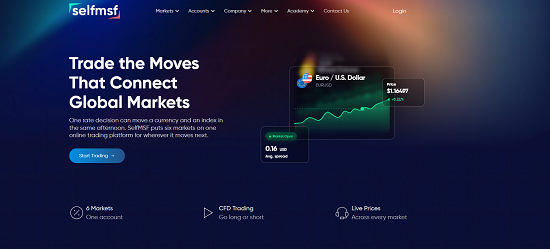
SelfMSF is an online CFD trading platform built around access to global markets including forex, cryptocurrencies, stocks, indices, commodities and metals. Rather than requiring traders to own the underlying asset directly, the platform uses contracts for difference, or CFDs, to provide exposure to price movements.
That distinction is one of the first things worth understanding about Selfmsf.com
SelfMSF Is Built Around CFDs
A CFD is a contract based on the price movement of an underlying market. The trader does not necessarily own the share, currency, commodity or cryptocurrency itself. Instead, the result of the position depends on the difference between the price when the CFD is opened and the price when it is closed.
This structure allows traders to take both long and short positions. A long position is generally used when the trader expects the market price to rise, while a short position is used when the expectation is for prices to fall.
That flexibility is one reason CFDs are widely used for active trading. The other is margin.
CFDs are commonly leveraged products, which means the trader may only need to commit a portion of the total position value as margin. That can make capital use more flexible, but it also increases risk because gains and losses are calculated on the full position rather than simply on the amount placed as margin.
SelfMSF’s own educational structure places emphasis on CFD mechanics, leverage, margin and risk, which is important because those concepts are more relevant to understanding the platform than the design of the trading screen.
Which Markets Are Available on SelfMSF?
That range of trading markets gives traders exposure to several very different types of market behaviour.
Forex trading focuses on currency pairs, where prices can react strongly to interest-rate decisions, inflation figures, employment data and central-bank policy. Major currency pairs generally involve currencies such as the US dollar, euro, British pound or Japanese yen, while other pairs may reflect more regional economic developments.
Stock CFDs provide exposure to the price movement of individual companies without necessarily requiring direct ownership of their shares. Company results, earnings forecasts, product announcements and wider sector conditions can all affect those prices.
Indices provide a broader view. Instead of following one company, a trader can track the performance of a larger group of companies through an index. This can make indices useful for traders interested in general market sentiment rather than one individual business.
SelfMSF also includes cryptocurrencies, metals and commodities. Crypto markets are known for high volatility and extended trading hours. Metals such as gold and silver may react to changes in interest rates, currencies and broader market uncertainty, while commodities such as oil can respond to supply, inventories, global demand and geopolitical developments.
The benefit of the SelfMSF structure is not simply that several markets are available. It is that a trader can follow different economic themes without maintaining several separate trading accounts.
One Economic Event Can Reach Several Markets
This is particularly relevant in 2026 because markets are increasingly analysed together rather than as isolated instruments.
Consider a major interest-rate decision. The first reaction may appear in a currency pair, but the same announcement may also influence equity indices, gold and rate-sensitive stocks. A sharp change in oil prices can affect inflation expectations, while a large technology-company earnings report can influence both the individual stock and the index in which it has a significant weighting.
A multi-market platform such as SelfMSF gives traders the ability to follow several of those reactions within one environment.
That does not mean every trader needs exposure to every market. It simply gives them more context and more choice.
More choice can also create more risk if positions are poorly managed. A trader holding a stock CFD, an index CFD and a crypto CFD may appear diversified while still being heavily exposed to the same broad shift in market sentiment.
The number of positions matters less than understanding what is driving them.
Margin Is Central to Understanding SelfMSF
Anyone considering SelfMSF should understand margin before looking at individual markets.
Imagine a CFD position with a total value of $10,000. If the trader is required to commit only $1,000 as margin, the market exposure is still $10,000.
A 1% move in the market therefore represents $100.
Relative to the full position, that is 1%. Relative to the $1,000 committed as margin, however, the effect is 10% before costs.
This is why leverage can make both positive and negative market moves much more significant relative to the capital committed.
The useful question is not simply, “How much margin do I need?”
It is, “How large is the position I am actually controlling?”
Traders should also consider overnight financing, available account equity, margin calls and the level at which positions may be closed if available funds become insufficient.
Margin can make trading more flexible. It does not make market direction easier to predict.
SelfMSF and Trading Costs
CFD trading can involve several different types of cost, and users should understand all of them before opening a position.
The first is the spread, which is the difference between the buying and selling price. A position generally begins slightly negative because the price must first move far enough to cover that spread.
Depending on the instrument and account structure, commissions may also apply. Leveraged positions held overnight can carry financing charges, which become increasingly relevant when a position remains open for several days or weeks.
Currency conversion can create another cost when the account currency differs from the currency in which a market is priced.
The important point is that a trader should look at the total cost of the position rather than focusing on one headline number.
A relatively narrow spread may not make a long-term leveraged position inexpensive if overnight financing accumulates over time.
Security Is More Than a Password
SelfMSF also places emphasis on account security.
The platform currently highlights measures including two-factor authentication and additional verification around withdrawals. Two-factor authentication creates another security layer beyond the account password and is one of the simplest protections users can enable.
Withdrawal checks are equally important because the movement of money out of the account should require stronger verification than an ordinary login.
Users still carry part of the responsibility for security. A unique password should be used for the SelfMSF account, and the email account linked to it should also be protected. Traders should avoid logging in through unfamiliar links, shared computers or unsecured public networks.
This matters because financial fraud does not always involve someone hacking the platform itself. Phishing websites and fake login pages can imitate genuine trading services closely enough to capture passwords or verification codes.
Technical security protects the account infrastructure. User behaviour protects access to it.
How SelfMSF Approaches Education
One of the more useful parts of SelfMSF is that education is not limited to basic platform navigation.
The site includes educational material around CFD trading, leverage, risk management, fundamental analysis and technical analysis. It also provides a glossary designed to explain trading terminology in more straightforward language.
That is a sensible mix because CFD traders need to understand more than market direction.
Technical analysis focuses on price, trends, momentum and chart behaviour. Fundamental analysis looks more closely at economic data, company results and broader market drivers. Risk management deals with position size, leverage and how much of the account is exposed to one idea.
These subjects overlap.
A trader may have a strong fundamental view and still choose poor timing. Another may find a technically attractive setup immediately before an economic event changes the market.
Education is most useful when it helps traders connect these parts rather than treating every indicator or concept as a separate strategy.
Where AI Fits Into Modern Trading
AI has also become part of the research process for many traders in 2026.
It can summarise earnings reports, explain economic data, compare companies or turn a long central-bank statement into a shorter list of relevant points. That can save time, especially when traders are monitoring several markets.
The limitation is reliability.
An AI-generated explanation can be incomplete, outdated or simply wrong. Traders should therefore use AI as an information-processing tool rather than as a replacement for the original source or a guaranteed trading signal.
A practical workflow might involve using AI to summarise a company earnings release, checking the original announcement and then opening the relevant stock or index on SelfMSF to see how the market is actually responding.
The distinction is simple: AI can help explain information. It cannot guarantee the next price movement.
Account Opening With SelfMSF
The SelfMSF account-opening process is structured around registration, verification, funding and access to the platform.
Users generally begin by entering personal information and completing identity checks. Verification is important because trading and payment accounts need to establish who owns and controls the account.
After verification, the user can select an available funding method and add money to the trading account.
Before funding, users should check the current account requirements, minimum deposit, payment methods and any fees that may apply. They should also review the legal terms and risk disclosure rather than moving directly from registration into trading.
A short registration form does not mean the underlying products are simple.
The onboarding process may take minutes. Understanding leveraged CFDs should take considerably longer.
Deposits and Withdrawals
Payments are another area where users should look at the details rather than the headline.
SelfMSF provides deposit and withdrawal functionality through the account environment, with payment options depending on what is currently supported for the user.
Withdrawal requests may require additional identity and payment verification before funds are released. That is normal for financial platforms because the company needs to confirm that money is being returned to the legitimate account holder.
Users should check processing times, any minimum withdrawal amounts, possible payment-provider fees and whether the withdrawal method needs to match the original funding method.
It is always better to understand this process before making the first deposit.
A platform should not be judged only by how quickly money can enter the account.
How clearly money can leave matters at least as much.
Mobile Trading Has Become Part of the Basic Experience
SelfMSF also supports trading and account access across mobile devices.
For many users, that is now a basic requirement rather than a premium feature. A trader may begin research on a desktop, monitor an open position from a phone and check an account later without returning to the same device.
Mobile access can be particularly useful for markets that remain active outside normal office hours.
But constant access can also lead to unnecessary trading.
A platform in the pocket makes it easy to check prices repeatedly, react to short-term volatility or open a position because the market happens to be moving.
Mobile trading is most useful when it supports an existing plan rather than replacing one.
Who Is SelfMSF Likely to Suit?
SelfMSF appears most relevant to users interested in active, multi-market CFD trading rather than traditional buy-and-hold investing.
Its market range makes sense for traders who want to follow currencies one day, stocks or indices another, and perhaps metals, commodities or crypto when those markets become more active.
The education section may also make the platform more approachable for users who are still becoming familiar with leverage, technical analysis or CFD terminology.
More experienced traders will probably pay greater attention to the detailed trading conditions: spreads, financing costs, execution, available order types and margin requirements.
Those details should be checked against the trader’s own strategy rather than assuming one platform setup fits everyone.
The Bottom Line on SelfMSF
SelfMSF is a multi-market CFD platform built around access to forex, crypto, stocks, indices, metals and commodities from one trading environment.
Its strongest practical feature is the breadth of markets combined with education around the concepts that actually matter for leveraged trading: margin, risk, fundamental analysis and technical analysis.
Security features such as two-factor authentication and additional withdrawal checks add useful account protection, while mobile access reflects the way modern traders increasingly manage positions across different devices.
The most important point, however, is understanding what SelfMSF provides.
It gives users access to price movements through CFD products. It does not remove market uncertainty, and the use of leverage means losses can develop quickly when a position moves in the wrong direction.
For users considering SelfMSF in 2026, the sensible approach is to understand the CFD structure first, review the current costs and margin conditions, secure the account properly and only then decide which markets fit their trading approach.
The platform provides the access.
Understanding the exposure remains the trader’s job.