NEW YORK – Pakistan is making an unexpectedly early move into one of the more consequential policy debates shaping the future of global finance: who will set the rules for tokenised money, assets and financial infrastructure.
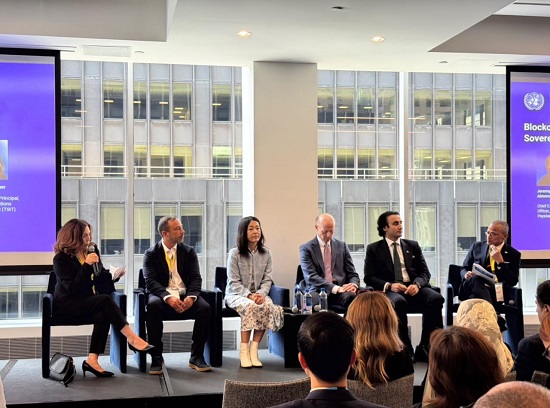
The shift was visible at the United Nations this week, where the Permanent Mission of Pakistan and the Pakistan Virtual Assets Regulatory Authority, PVARA, helped host a session during UN Digital Cooperation Day titled “Blockchain and the Tokenized Future: Sovereign Choices and Safeguards for Next-Gen DPI.” The official UN programme framed the discussion around tokenised securities, commodities and other assets, country readiness, public safeguards and whether tokenisation could ultimately become part of next-generation digital public infrastructure.
The composition of the session was notable. Pakistan’s Finance Minister Muhammad Aurangzeb and Tanzania’s Minister for Communication and Information Technology Angellah Kairuki delivered opening keynotes. Singapore’s Permanent Representative to the UN Burhan Gafoor joined Pakistan’s Minister of State and PVARA Chairman Bilal Bin Saqib on the panel alongside Circle CEO Jeremy Allaire, Paystand CEO Jeremy Almond and YZi Labs Managing Partner Ella Zhang. UN Under-Secretary-General Amandeep Singh Gill delivered the closing remarks.
That gave Pakistan something more consequential than another speaking slot at UNGA.
It helped convene the conversation.
For a country that has traditionally featured in international economic coverage through the lenses of debt, macroeconomic adjustment and geopolitical risk, the attempt to establish a place in discussions over emerging financial technology represents a different kind of international positioning.
From regulatory uncertainty to institution-building
Pakistan’s argument carries more weight because it has been accompanied by a rapid domestic regulatory build-out.
The Virtual Assets Act 2026 established PVARA as the country’s dedicated federal regulator for virtual assets. Pakistan subsequently notified its Virtual Asset Services Regulations and activity-specific regulations on August 21, covering areas including licensing, market conduct, cybersecurity, client-asset protection and AML/CFT requirements. The regulator now accepts applications across its sandbox, no-objection certificate and licensing pathways.
The pace has attracted attention inside Pakistan’s government.
Official disclosures state that the regulatory framework was put in place in under six months while using less than 8 percent of the authority’s approved budget, with the remainder returned to the exchequer.
Finance Minister Aurangzeb has separately commended the work of the PVARA team and its commitment to the national mandate. He has also publicly welcomed the authority’s engagement with international regulators and policymakers and encouraged it to translate those relationships into practical applications for Pakistan.
At the centre of the effort has been Bilal Bin Saqib, the Minister of State who chairs PVARA.
His argument has been that developing countries cannot afford to approach new financial technologies solely as consumers of infrastructure designed elsewhere. Pakistan, he has argued, needs to build regulatory capacity at home while participating internationally before standards around tokenised finance become entrenched.
The significance of the roughly six-month implementation timeline is therefore not simply speed.
It is an emerging argument about state capacity: whether a developing economy can create specialised institutions quickly, operate with relatively small teams and engage internationally without first constructing a large bureaucracy.
Whether that model proves durable will depend on implementation. Licensing, enforcement, institutional independence and consumer protection will matter far more in the long run than how quickly the initial rulebook was written.
But the early execution has given Islamabad something it previously lacked: a domestic platform from which to participate credibly in the global discussion.
The debate is no longer just about cryptocurrency
That discussion itself is also changing.
At the UN, Aurangzeb argued that tokenisation should be connected to practical economic needs such as cheaper remittances, SME financing, sovereign debt and wider access to financial services. He also called for private-sector innovation to operate alongside state safeguards, inclusive digital infrastructure and international cooperation.
Those priorities are important for Pakistan because the potential value of digital financial infrastructure extends well beyond speculative crypto markets.
Pakistan is examining whether new settlement and tokenisation technologies could eventually have applications in cross-border payments, government securities, sukuk, SME finance and other real-world assets.
The question is not whether everything should be placed on a blockchain. Quite the opposite.
The more mature policy argument emerging from Islamabad is that governments should begin with economic friction and then determine whether tokenisation actually improves the solution.
For developing economies, that distinction matters. A technology that lowers the cost of remittances or expands access to capital has a fundamentally different development case from one whose principal purpose is speculative trading.
A seat at the table before the standards harden
Perhaps the most important aspect of Pakistan’s New York intervention was therefore geopolitical rather than technological.
Digital financial systems are inherently cross-border, while most financial regulation remains national.
A tokenised security could theoretically be issued in one country, held through infrastructure in another, settled using a digital instrument domiciled elsewhere and purchased by an investor in a fourth jurisdiction.
That creates questions about legal ownership, settlement, custody, AML/CFT, investor protection and regulatory responsibility that no country can solve alone.
Pakistan’s Finance Minister used the UN platform to argue that emerging economies should be involved in shaping those global standards rather than simply implementing them later.
This is where the UN event may ultimately matter most for Pakistan’s international positioning.
Singapore is already one of the world’s most sophisticated financial centres. Circle is a major private-sector player in digital money. Tanzania represents another emerging-market perspective. Their participation alongside Pakistan demonstrated that the debate over tokenisation is no longer confined to crypto conferences or technology companies.
Pakistan is not yet a global centre of tokenised finance, and it would be premature to describe it as one.
But it is attempting something potentially more significant at this stage: entering the policy conversation before the architecture is complete.
For a country that has often arrived late to major technological transitions, that itself represents a shift.
The test now is whether Pakistan can turn international positioning into domestic execution.
If it can, its emerging role in digital finance may begin to change not only how Pakistan regulates technology, but how the country itself is perceived internationally.