As the United States nominates Austin Holmes to serve as Ambassador to Haiti, HDNF urges greater accountability, local ownership, and measurable investment in Haitian institutions and communities
WASHINGTON — September 16, 2026 — The Haitian Development Network Foundation (HDN Foundation) welcomes President Donald Trump’s nomination of Austin Holmes of Florida to serve as U.S. Ambassador Extraordinary and Plenipotentiary to the Republic of Haiti and thanks President Trump for moving to restore a permanent ambassadorial presence at a critical moment for Haiti.
The nomination, announced by the White House on September 14, 2026, has been submitted to the U.S. Senate for consideration. Holmes has longstanding experience working in Haiti and has been involved in humanitarian, security, and development-related efforts in the country. His nomination comes as Haiti confronts severe insecurity, institutional challenges, humanitarian needs, and preparations for a national electoral process.
HDN Foundation believes the nomination provides an opportunity to reassess how the United States and Haiti can build a more effective partnership—one that places greater emphasis on Haitian institutions, Haitian communities, and sustainable local capacity.
That question is particularly important in light of the experience of the Global Fragility Act (GFA).
A Strategy Designed to Prevent Fragility
The Global Fragility Act, enacted with bipartisan support in 2019, established a long-term U.S. Strategy to Prevent Conflict and Promote Stability. Haiti was selected as one of the strategy’s priority countries, with the broader objective of addressing the drivers of instability through coordinated, long-term engagement rather than relying solely on short-term crisis response.
The U.S. strategy envisioned a progression from security and stabilization toward stronger governance, economic opportunity, civic engagement, skills development, and locally owned systems.
HDN Foundation’s recent analysis, “You Break It, You Fix It: What the Global Fragility Act Promised Haiti — and What It Delivered,” argues that the results should now be evaluated against those original objectives.
HDN Foundation does not contend that the United States created Haiti’s fragility. Haiti entered the period of GFA implementation facing profound political, economic, security, and institutional challenges. Rather, HDN Foundation argues that a strategy intended to help reverse fragility must be measured by whether conditions improve and whether external assistance translates into durable Haitian capacity.
The foundation points to a central concern: substantial U.S. assistance has continued to reach Haiti, but dedicated resources for long-term prevention and stabilization have been comparatively limited, while the country’s security and humanitarian conditions have continued to deteriorate.
The U.S. Department of State has described the GFA framework as a 10-year effort intended to strengthen stability and support locally driven solutions.
From Assistance to Sustainable Capacity
For HDN Foundation, the lesson is not that international assistance should end. Haiti continues to need humanitarian, security, economic, and institutional support.
The lesson is that assistance must increasingly build capacity that remains in Haiti.
“Foreign assistance can save lives, but lasting stability requires more than assistance,” said Jacques Jonassaint, Chairman and CEO of the Haitian Development Network Foundation. “Haitians must be able to own the institutions, businesses, farms, skills, infrastructure, and systems that determine their future. The objective should not simply be to manage Haiti’s crisis. It should be to help Haitians build the capacity to overcome it.”
HDN Foundation believes future U.S.-Haiti cooperation should place greater emphasis on:
- Strengthening Haitian public institutions and local governance;
- Supporting accountable and capable justice and security institutions;
- Expanding vocational and technical education;
- Increasing agricultural productivity and food security;
- Supporting Haitian entrepreneurs and locally owned businesses;
- Creating economic opportunities for Haitian youth and women;
- Engaging the Haitian diaspora as a development partner;
- Measuring outcomes through community-level improvements in safety, livelihoods, food access, and institutional trust; and
- Ensuring that foreign-funded programs transfer knowledge and capacity to Haitian institutions rather than creating permanent dependence on external implementers.
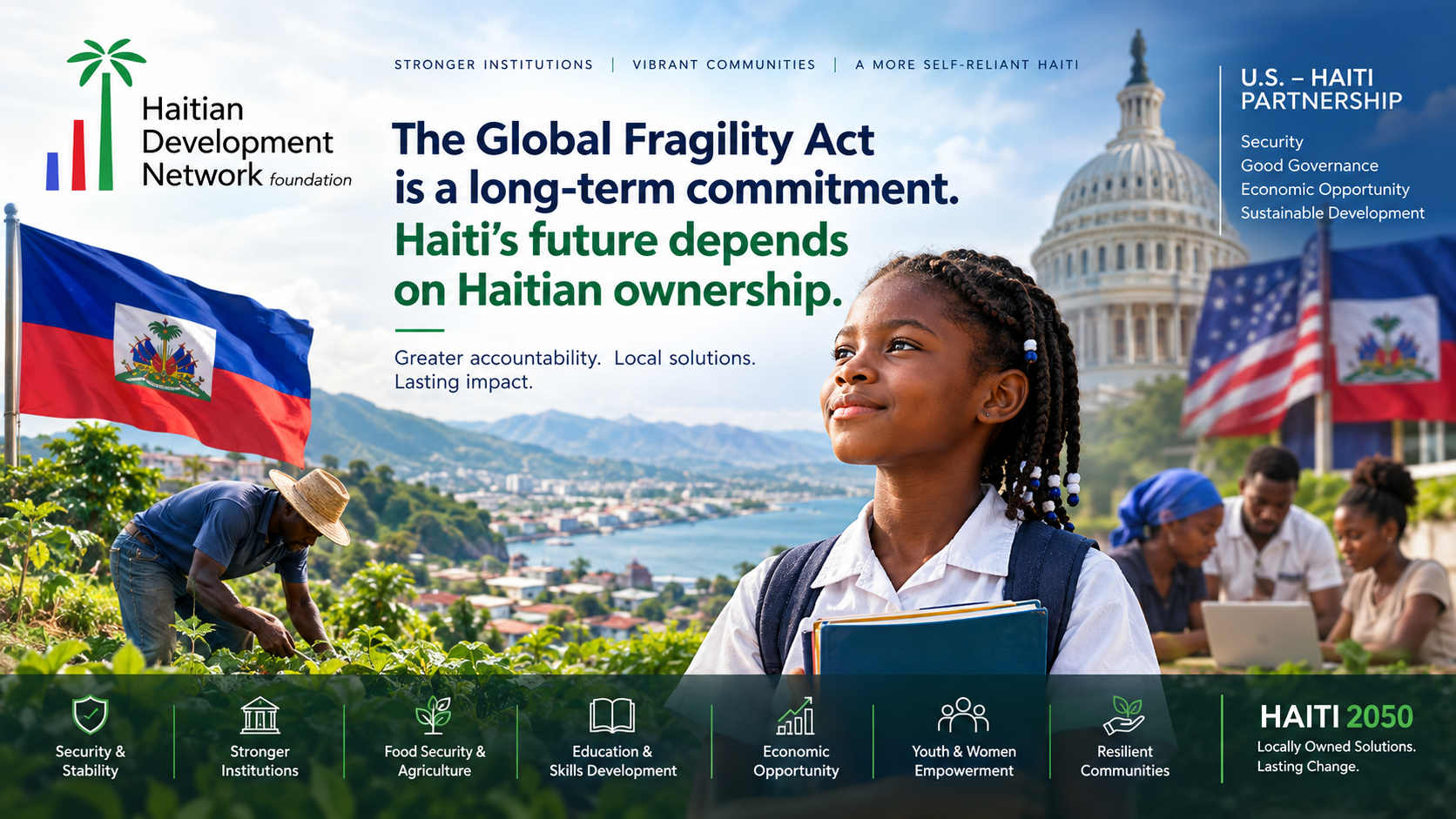
A New Opportunity for U.S.-Haiti Partnership
HDN Foundation views the nomination of Austin Holmes as an opportunity for renewed engagement between the United States and Haiti.
The foundation believes the next phase of U.S.-Haiti relations should combine security and humanitarian assistance with a stronger development strategy centered on Haitian ownership.
Haiti needs security to function. It also needs functioning institutions, productive agriculture, reliable public services, education, economic opportunity, and communities capable of building their own future.
“Security and development should not be treated as competing priorities,” Jonassaint said. “A secure Haiti must also become a productive Haiti, a food-secure Haiti, and a Haiti where citizens can build sustainable livelihoods. The United States can play an important role, but Haitian people and institutions must remain at the center of that effort.”
HDN Foundation’s Haiti 2050 vision is built around this principle of locally owned development. The foundation’s work connects food security, agriculture, technical skills, energy independence, economic inclusion, and community resilience with the broader goal of helping Haitian communities become more self-reliant.
Looking Beyond the Next Crisis
HDN Foundation believes the experience of the Global Fragility Act should encourage both the United States and Haiti to examine what has worked, what has not, and where resources can produce lasting results.
The foundation is calling for a partnership measured not simply by the amount of assistance delivered, the number of programs implemented, or the number of security operations conducted, but by whether Haitian communities become safer, more productive, more self-reliant, and better equipped to sustain progress.
As Haiti moves toward an important period of political and institutional transition, HDN Foundation believes the country and its international partners have an opportunity to move from repeated crisis management toward a long-term development model built around Haitian ownership.
“The goal should be simple,” Jonassaint said. “Not another promise that Haiti will become stable, but a partnership that helps Haitians build the systems and capabilities required to make stability sustainable.”
HDN Foundation remains committed to working with Haitian communities, institutions, the Haitian diaspora, international partners, and the private sector to advance a more self-reliant and resilient Haiti.
About Haitian Development Network Foundation
The Haitian Development Network Foundation (HDN Foundation) is a nonprofit organization focused on sustainable development, food security, economic inclusion, education, community resilience, and long-term self-reliance in Haiti. Through its Haiti 2050 vision, HDN Foundation works to support locally owned solutions that strengthen Haitian communities and expand opportunities for sustainable development.
HDN Foundation is a nonpartisan nonprofit organization and does not endorse or oppose any political party or candidate. Its advocacy focuses on long-term development, institutional capacity, economic opportunity, and sustainable solutions for Haiti.
Media Contact
Jacques Jonassaint
Haitian Development Network Foundation
Email: [email protected]
Website: www.hdn.org